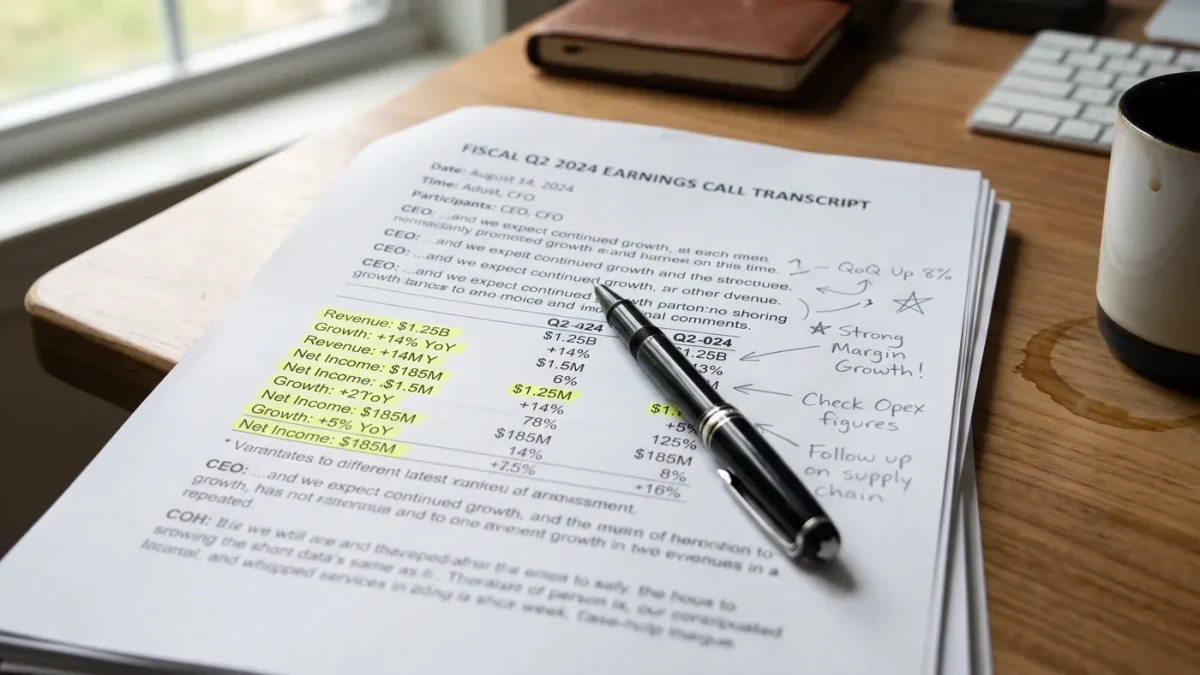
When Enron's executives told analysts the company was "in its strongest financial condition ever" months before collapse, the words outlived the company — and they were not an exception but a category: analyses of executive language find measurable, systematic differences between the speech of firms about to disappoint and firms about to deliver, documented in the accounting and finance literature on conference-call deception. Earnings calls are performances under disclosure rules; reading them well is part listening, part pattern recognition.
Why does language carry information at all?
Because executives know more than they can legally say, and the pressure of a live question period leaks it around the edges. Prepared remarks are lawyered, rehearsed, and scrubbed; the question-and-answer is improvisation under pressure, with executives answering unscripted questions in real time. The deception-detection literature — built on text analysis of thousands of call transcripts against subsequent outcomes — finds that executives concealing problems systematically use more references to general knowledge ("as you know"), fewer first-person pronouns, more extreme positive emotion, and fewer precise quantifications. None of these flags an individual lie; each marks a statistically elevated group probability, the same way elevated heart rate marks exertion without specifying the cause.
What are the classic evasion phrases?
The taxonomy is stable across decades of calls. Vague timing: "in the coming quarters," "as we move through the year," "over time" — attached to a promise, these phrases remove every date that could be checked; a genuine plan comes with a quarter attached. Blame externalization: every setback attributed to macro, weather, or "one-time headwinds," every success credited to execution — the pattern that concerns analysts is consistency, not any single instance. The unfalsifiable: "we're seeing strong demand signals," "the pipeline has never been better" — claims without numbers cannot be wrong, which is precisely why they carry no information. The pre-emptive burial: bad news delivered inside a heap of good news, late in the call, in the passive voice — "a decision was made to restructure certain operations." Each phrase is legal, common, and occasionally innocent; the analyst's job is watching which ones cluster.
What are the accounting tells?
The phrases that touch the numbers themselves deserve the sharpest attention, because accounting choices precede restatements. "We've adopted a more appropriate revenue recognition policy" — revenue recognition changes move current revenue at the expense of future, and the phrase has preceded multiple enforcement actions in SEC history. "One-time" recurring: a charge labeled one-time that appears every quarter is a recurring cost wearing a costume, as this publication's non-GAAP analysis details. The audit-adjacent tells: any friction with the auditor — a changed firm, a delayed filing, a "disagreement over application of standards" disclosed in an 8-K — is the accounting equivalent of smoke. Deferred revenue drawdowns praised as "revenue optimization": spending the backlog is spending the future. These tells share a structure — they are technically true statements whose full meaning requires the footnote the speaker hopes you will not read.
What about tone shifts from prior calls?
The single most informative language datum is not any phrase but the change in phrases — the same management team's vocabulary against its own history. A finance chief who quantified guidance for two years and suddenly offers qualitative direction is telling you something about visibility, whatever the words claim. An executive who answered margin questions directly last quarter and this quarter answers with market-share soliloquies is telling you something about margins. Conference-call regulars maintain transcripts precisely for this diff-reading: pull the last four calls, strip the numbers, and compare the connective tissue. The method requires no expertise beyond patience — the changes are usually visible to any careful reader within minutes.
Who asks questions matters too?
The questioner lineup is quieter information than any answer. Analysts at the bulge-bracket firms research the company continuously and calibrate their questions to their models' pressure points — so the questions themselves reveal where sophisticated attention is focused. When the sharpest question of a call concerns a segment footnote few retail listeners knew existed, the follow-through belongs in your own file. And the rotation matters: a company that stops calling on the analysts who pressed hardest last quarter is managing its audience, a practice that predates every modern disclosure rule and survives them all.
How did quantitative language analysis change the game?
It industrialized what skilled listeners did by ear. Academic work — notably the deception-detection research of Larcker and Zakolyukina — scored call language against later outcomes and found systematic predictive patterns; commercial services followed, scoring sentiment, evasion, and executive certainty by machine across thousands of transcripts per season. The arms race works both ways: executives and investor-relations advisors now train for calls, knowing the machines are listening, and polished delivery has improved as detection has. The durable consequence for readers: the most heavily lawyered, most rehearsed passages are the least informative — which raises, rather than lowers, the value of the unscripted corners, where preparation is thinnest and the tells live.
What questions do good analysts ask — and why should readers care?
The follow-up is where calls are won. Strong analysts ask for numbers management did not volunteer — the quarter's actual unit volumes, the percentage of growth from price versus volume, the dollar effect of the headwind just mentioned — and the evasion pattern in the answer is data. Readers should care because the question-and-answer distribution is public: which analysts got follow-ups answered versus deflected, which topics management took offline versus addressed live, and whether the call ended early. A company that once ran long and now hangs up early is a company whose calls got harder, and the schedule is an underrated signal with no language analysis required.
What is the disciplined practice for a listener?
- Read the release before the call — the numbers anchor the words, and reversing the order invites manipulation.
- Listen once for content, then re-listen or read the transcript for evasion markers: vague timing, externalized blame, unfalsifiable claims, buried negatives.
- Diff against the prior two calls' transcripts; weight changes in vocabulary and specificity above any absolute phrasing.
- Check the accounting tells in the filings the call references — the footnote is where technically-true statements go to become fully true.
- Grade the question-and-answer: which questions got numbers, which got philosophy.
What are the honest limits of call reading?
Three. Base rates: most flagged language is innocent — legal caution, genuine uncertainty, ordinary corporate idiom — and treating every vague phrase as a smoking gun produces false positives at rates the research is candid about. Selection: the spectacular cases (the Enrons) are memorable precisely because language failed to warn most listeners in time; the method improves odds at the margin, not certainty at the core. And adaptation: as tells become famous, they evolve — the modern executive's tell is often the absence of tells, an over-polished nothing of a call. The last defense remains the oldest: compare what management says with what the filings state, quarter after quarter, and trust the document over the performance when they diverge.
Where can readers do all this themselves?
Transcripts publish within hours through the free services and the companies themselves; filings are on EDGAR; the academic deception-detection studies are publicly posted and readable in an evening. The entire discipline runs on public materials — which, fittingly, is the same standard this publication holds itself to every time it quotes a call.
The final habit ties the series together: calls are claims, filings are records, and prices are bets. Skepticism on calls is not cynicism — it is the simple discipline of grading claims against records over time, which is the only grading that cannot be rehearsed.