Every U.S. public company must file a Form 10-K annually — a standardized, audited document running a hundred pages or more whose footnotes have moved markets, exposed frauds, and rewarded patient readers, per SEC filing requirements. Warren Buffett's oft-quoted practice of reading them cover to cover is famous; the practical skill is knowing where to look first. Market Today publishes information, not investment advice, and this explainer is a working guide to the document itself.
What is a 10-K, legally?
The company's complete annual report to the Securities and Exchange Commission, required by the Securities Exchange Act for all publicly traded companies, with deadlines scaled to size — large accelerated filers get sixty days after fiscal year-end, others seventy-five or ninety. Unlike the glossy annual report mailed to shareholders, the 10-K carries legal liability: executives certify its accuracy under Sarbanes-Oxley, the financial statements are audited by an independent registered public accounting firm, and material misstatements carry SEC enforcement exposure. That liability structure is why the document's dry language repays close reading — companies are careful precisely where the risk is real. It also explains the document's characteristic silence: legal caution makes disclosure exact, and exactness reads as dullness. The skill of a 10-K reader is partly literary — learning where in the boilerplate the load-bearing sentences sit.
What are the parts, and which carry weight?
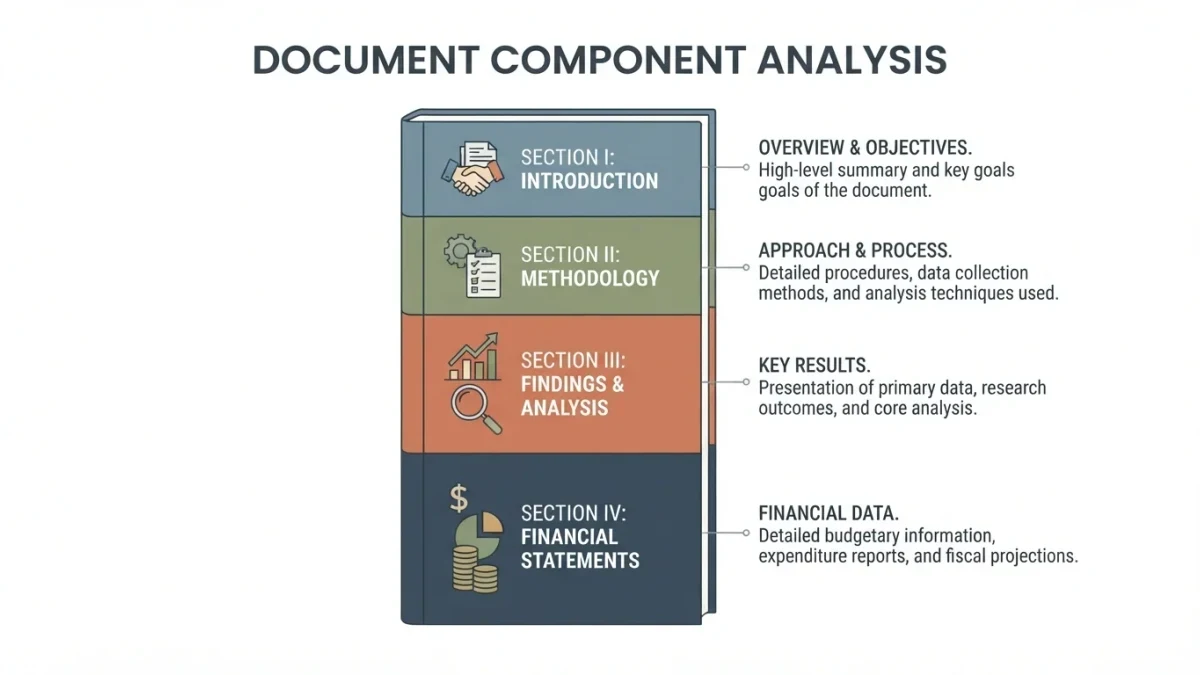
Four sections matter most. Business (Item 1) describes the company, its segments, and its competition — worth reading once per company, slowly. Risk Factors (Item 1A) lists what could go wrong; the craft is in changes year over year, because risk factors are where companies disclose things they fear, in the dullest possible language. MD&A (Item 7), the management discussion and analysis, walks through operations in management's own words — the comparison of this narrative against the numbers is where discrepancies surface. Financial Statements and Notes (Item 8) contain the audited statements and the footnotes — the part professionals read first and retail readers skip, which is exactly backwards from most guides' advice.
Why do the footnotes deserve the first hour?
Because the numbers that matter are frequently not on the face of the statements. The revenue recognition note explains when the company books sales — the core question in dozens of major accounting frauds, from the channel-stuffing cases of past decades forward. The lease, pension, and debt notes carry the obligations that shape future cash flows. The segment note — which this publication has highlighted elsewhere — breaks the business into the pieces management itself runs, and its margins often tell a different story than the consolidated totals. The related-party transactions note discloses deals with insiders. Accounting standard-setters require this disclosure precisely so readers can find it; the competitive advantage goes to those who actually do.
How do you read the auditor's report?
As a health check with a specific vocabulary. The audit opinion states whether the statements fairly present the financial position — and the critical audit matters, required since 2019, name the areas the auditor found hardest to verify: complex estimates, unusual transactions, judgment-heavy reserves. A clean opinion is the baseline, not a gold star; the information is in which items the auditor flagged as difficult and whether those flags change year over year. A changed auditor, a delayed filing, or an adverse or qualified opinion escalates through the document hierarchy from routine to alarming, and each of those events is public on EDGAR the day it happens.
What should a three-hour first pass look like?
- Read the cover page and check the auditor, the filer status, and the fiscal year — thirty seconds of orientation.
- Read the segment note and map the business into its real pieces, with each piece's revenue and profit.
- Read the cash flow statement in full: operating cash flow versus reported net income, tracked across three years, is the single most efficient forensic ratio in the document.
- Read the revenue recognition note and the debt note, marking anything that takes a paragraph to explain.
- Read the MD&A and risk factors, comparing against last year's file — the diffs are the signal.
- Skim the legal proceedings and related-party notes for anything with numbers large enough to matter.
What about the proxy statement, the 10-K's companion?
The annual proxy — technically the DEF 14A, filed ahead of the shareholder meeting — completes the picture the 10-K starts. It discloses executive compensation in exhaustive tables, director biographies and board committee memberships, auditor fees split between audit and consulting work, and shareholder proposals. Compensation structure is the tell: how much of an executive's pay rides share price versus operating metrics, over what horizons, and against which peer group tells you what management is actually paid to optimize. Auditor-fee mix matters similarly — heavy consulting fees paid to the auditing firm are a long-standing independence question the disclosure rules were written to expose. The proxy arrives a few weeks to months after the 10-K on the same EDGAR page, and an hour with its tables converts abstract governance talk into numbers.
What are the classic red flags inside a 10-K?
The recurring suspects, all documented in SEC enforcement actions across decades: persistent gaps between net income and operating cash flow, which can mean earnings built on accruals rather than cash; ballooning receivables or inventory outpacing sales, the channel-stuffing signature; margin trends that defy the company's own industry for no stated reason; risk-factor language that changes materially — new litigation, new regulatory, new going-concern-adjacent phrasing; and non-GAAP adjustments that recur every quarter while management calls them one-time. None of these is proof of anything alone; each is a question the rest of the document should answer, and unanswered questions are findings in themselves.
How do you compare 10-Ks across companies?
Through the standardized parts, with humility about the rest. The statements follow uniform accounting standards, so ratios — margins, returns on capital, leverage, cash conversion — compare cleanly across an industry. The narratives do not compare cleanly: every company writes its own story with its own adjectives. The working habit professionals use is a simple spreadsheet per industry: three years of revenue, operating income, operating cash flow, and debt, per company, all pulled from the same standardized lines. The exercise takes an evening per industry and replaces narrative comparison with numerical comparison — a fairer fight.
What can a 10-K not tell you?
Three things honestly. It cannot tell you the future: it is a document about periods that have already closed, and its forward-looking safe-harbor language is legally protected optimism. It cannot tell you what management is not required to disclose — competitive contracts, private-company financials, customer intentions. And it cannot tell you what the stock is worth: valuation is a separate discipline that uses the 10-K's facts but supplies its own judgment. Readers who expect the document to be an oracle abandon it; readers who use it as the most reliable public fact base in investing keep it open, and the record — from short-sellers to long-term compounders — favors the second group.
Where do you get 10-Ks, and what tools help?
All filings are free on the SEC's EDGAR database — search a company, open its 10-K, and the full document downloads as text. The SEC's investor education materials explain the form's structure plainly. No subscription is required for anything described above; the entire practice runs on EDGAR, a spreadsheet, and patience, which is either the method's limitation or its charm.
One habit compounds the whole practice: build a personal file per holding — this year's 10-K, last year's, and a page of notes on what changed. The second year of reading any company takes half the time and teaches twice as much, because the document's real information lives in its deltas. Third-year readers rarely go back to commentary at all.