
A digital dollar — a central-bank digital currency, CBDC, giving the public a direct claim on the Federal Reserve in electronic form — remains, as of 2026, an American research project and a political argument rather than a built thing: an executive order in January 2025 prohibited the government from pursuing one, reversing the 2022 order that had launched the exploration, per the official proclamations. Meanwhile other jurisdictions have moved from papers to pilots to launches. Market Today publishes information, not investment advice, and this explainer covers where the idea stands and what the arguments actually are.
What is a CBDC, conceptually?
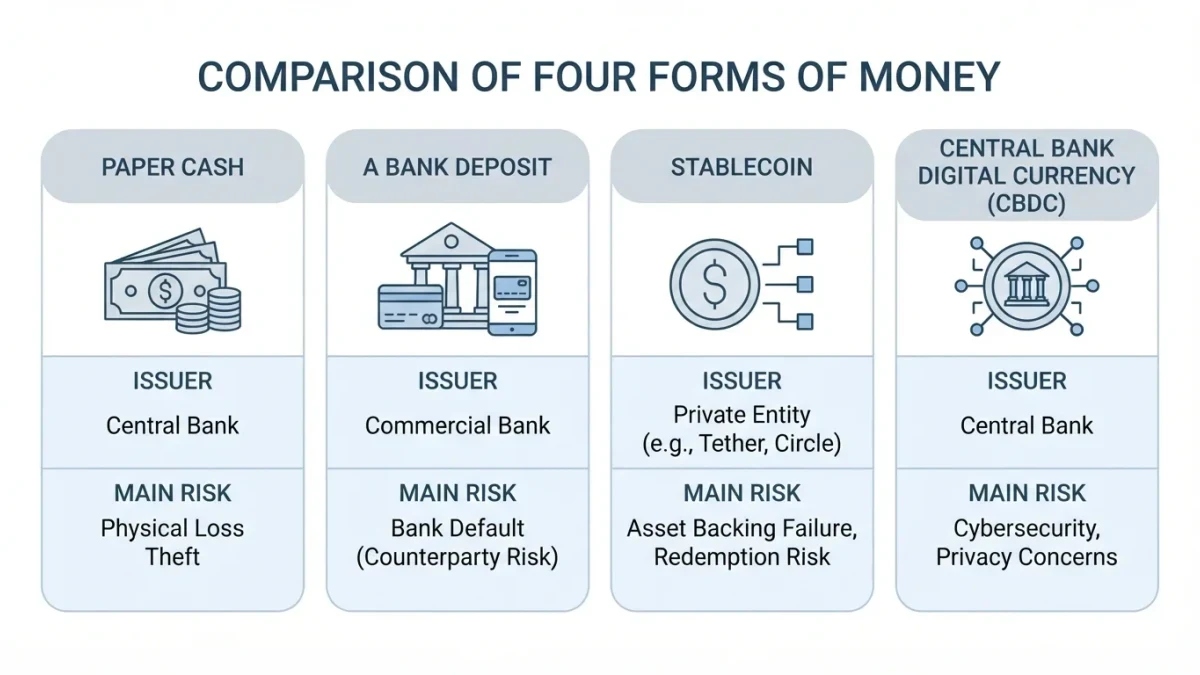
Digital money with central-bank backing — a third form of the currency alongside physical cash and commercial-bank deposits. Today the public holds central-bank money only as paper; everything electronic is a claim on a bank, with the central bank's money reserved for banks themselves through the reserve system. A retail CBDC would extend the central-bank claim to everyone: an account at, or a token from, the Fed itself, carried on phones or cards, with no commercial bank in between. Wholesale CBDC — the interbank version — is a narrower upgrade of what reserve systems already do. The design space is wide: interest-bearing or not, anonymous like cash or identified like deposits, intermediated through banks or direct, capped or uncapped — and each choice makes the CBDC a different instrument, which is why the debate rarely stays on one topic.
Why did the idea gain momentum?
Four forces converged in the late 2010s and early 2020s. Cryptocurrency demonstrated that public demand for electronic bearer-style money exists; stablecoins — private tokens pegged to the dollar, growing to hundreds of billions in circulation — demonstrated it again with regulators' increasing attention. Other central banks moved: China's e-CNY pilot expanded to hundreds of millions of users, the European Central Bank progressed its digital-euro project through investigation toward preparation, and smaller economies — the Bahamas' Sand Dollar, Nigeria's eNaira, Jamaica's JAM-DEX — launched, with mixed adoption, per the respective central banks' publications. And the 2020s' payment-infrastructure conversations — cross-border costs, financial inclusion, sanctions questions — gave central banks official reasons to study what a sovereign digital instrument could do. The Bank for International Settlements' surveys found most central banks engaged in some CBDC work — the idea's global momentum is documented even where launches stalled.
What did the United States actually do?
Studied, then see-sawed. The Boston Fed collaborated with the Massachusetts Institute of Technology on Project Hamilton, publishing open-source research demonstrating a high-throughput retail CBDC architecture in 2022-2023 — a technical proof of concept, explicitly not a policy endorsement. The 2022 executive order directed government-wide study of digital assets including a CBDC, with the Treasury and Fed producing analysis; Fed officials, including the chair, consistently stated that Congressional authorization would be required to issue one — a bar no bill cleared. The 2025 executive order then prohibited agencies from establishing, issuing, or promoting a CBDC, casting the idea as a surveillance risk — and, in the same document, endorsed stablecoins and considered a strategic bitcoin reserve instead, per the order's text. The result: the world's largest currency-issuer is officially out of the CBDC business for now, while its regulators build frameworks for the private dollar tokens that perform a neighboring function.
What are the arguments for a digital dollar?
The case supporters make, with evidence. Payments competition: card networks' interchange fees and the slow ACH system have measurable costs a public option could discipline — the Fed's own instant-payment system, FedNow, launched in 2023 as a partial answer. Financial inclusion: the unbanked — roughly four to five percent of U.S. households, per Federal Deposit Insurance Corporation surveys — could hold central-bank money without minimum balances. Monetary plumbing: a CBDC could make stimulus payments instantaneous and universal, an idea the pandemic's paper-check delays illustrated. Currency internationalization: dollar CBDC could anchor the currency's role as foreign rivals build alternatives. Each argument has counter-evidence and each is stronger in some designs than others; none has yet overcome the opposition.
What are the arguments against?
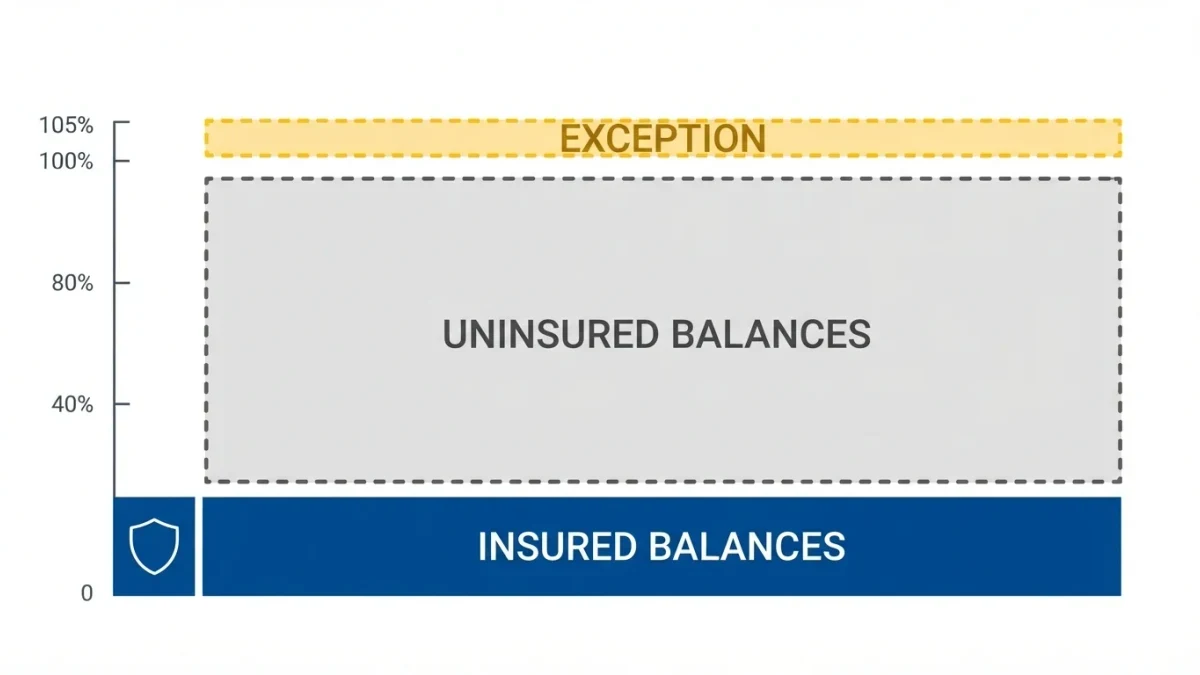
Three clusters dominate. Privacy: a Fed-issued digital currency is, in its identified designs, a ledger the government could in principle observe or control — the surveillance critique that drove the 2025 prohibition, and a real design tension no technical paper has dissolved. Bank disintermediation: if the public can hold Fed money directly, deposits could flee banks in stress — a run accelerant, unless CBDC holdings are capped or non-interest-bearing, per the Fed's own discussion papers. And sufficiency: America's payment problems are being solved by other means — FedNow, real-time payment rails, a regulated stablecoin framework — making the CBDC a solution searching for a problem, in critics' telling. The European and Chinese projects confront the same triad; their answers — holding caps, privacy tiers, offline functionality — are the live experiments American policy has declined to join.
Where do stablecoins fit the story?
As the private-sector shadow of the same question. A regulated stablecoin is a digital dollar claim — but on a private issuer's reserve portfolio, not on the Fed. The 2025-2026 legislative push established a federal framework for their issuance, per the enacted statute's framework, and the largest issuers' circulations grew into the hundreds of billions — private digital dollars now exceeding many countries' money supplies. The irony of the current settlement is structural: the United States prohibited the public digital dollar and blessed private ones, outsourcing the CBDC function to companies whose reserves are, mostly, Treasury securities — the same instrument a CBDC would offer, with an intermediary's balance sheet attached. Whether that settlement is durable policy or a transitional arrangement is the live question the 2020s will answer.
What did the pilots abroad actually teach?
The adoption record is the quietest but most instructive dataset. The Bahamas' Sand Dollar launched first and remains a rounding error of that economy's money; Nigeria's eNaira saw single-digit adoption percentages despite incentives; Jamaica's JAM-DEX paid sign-up bonuses to modest effect — small economies with real inclusion rationales, and still the public mostly stayed with cash and mobile money, per the central banks' own usage reports. The larger projects show the same gradient: China's e-CNY circulates in the low single digits of currency in use despite years of promotion. The lesson travels: distribution is the moat, and banks, mobile-money providers, and card networks already have it. A CBDC without a distribution answer is architecture without an audience — a finding American skeptics cite and American advocates answer with the intermediated designs that would route a digital dollar through the very banks it conceptually bypasses.
What should readers watch going forward?
Four signposts. Legislative: any Congress that revisits CBDC authorization would reopen everything — watch the banking committees. Regulatory: the stablecoin framework's implementation and the issuers' reserve disclosures — the private digital dollar's credibility is being built or broken now. Technical: FedNow's adoption curve — instant payment's growth shrinks the CBDC use case in real time. International: the digital euro's build decision and e-CNY's cross-border pilots — if rivals' instruments claim settlement rails abroad, the geopolitical argument returns to Washington with force. None of the four requires prediction; all four publish on public schedules.
Where can readers verify all this?
The 2022 and 2025 executive orders, the Fed's CBDC discussion papers and Hamilton research, the FDIC inclusion surveys, the stablecoin statute, and the foreign projects' official reports are all public documents. The digital dollar debate is unusually well-papered — every claim above sits in a primary source, and readers who follow the signposts will know the outcome years before the headlines summarize it.
And the meta-lesson of the decade holds regardless of outcome: money's form is now a policy instrument that governments actively design — a change from the era when currency just was. Readers who accept that premise stop asking whether a digital dollar is coming and start asking which of its functions the public sector, the banks, and the private issuers will each end up holding — the question the evidence is already answering, one pilot at a time.