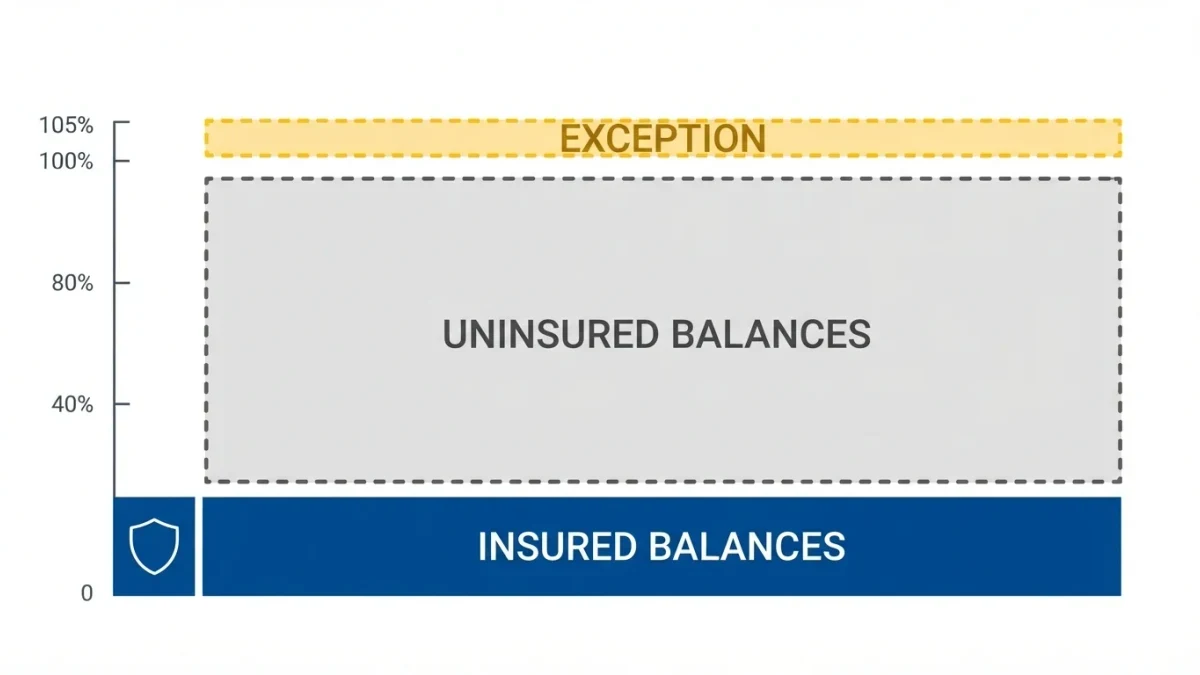
When Silicon Valley Bank failed in March 2023, roughly ninety-four percent of its deposits were uninsured — above the Federal Deposit Insurance Corporation's quarter-million-dollar limit — and the government guaranteed them all the same weekend, invoking systemic risk, per Treasury's official invocation. The episode reopened every question deposit insurance was designed to settle.
What does deposit insurance actually cover?
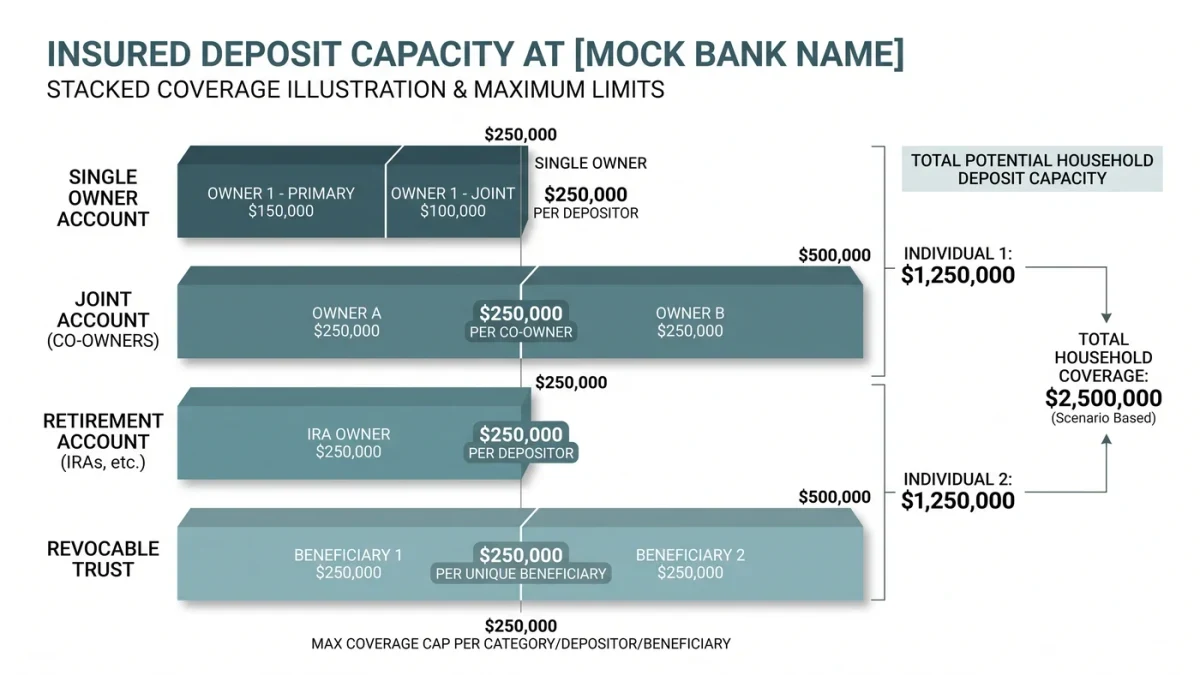
Deposits at member banks up to two hundred fifty thousand dollars per depositor, per ownership category, per insured bank — not per account, a distinction that matters. A family can stack coverage through ownership categories — single accounts, joint accounts, retirement accounts, trust categories each carrying their own limit at the same bank — and across institutions, a fact the brokerage sweep industry industrializes. Coverage extends to checking, savings, money-market deposit accounts, and certificates of deposit; it does not extend to money-market funds, mutual funds, or any investment product, a boundary consumers confuse routinely and the FDIC's own materials labor to clarify. The fund insures banks; the Securities Investor Protection Corporation's separate regime covers brokerage customers against custodial failure, not market losses — three guarantees with different perils, often conflated into one imagined safety net.
How is the system funded and governed?
By banks, not taxpayers by design. Member banks pay assessments — risk-based premiums scaled to supervisory ratings and balance-sheet composition — into the Deposit Insurance Fund, which stands behind the guarantee; the fund's reserve ratio is managed against a statutory target, and after 2023's failures consumed billions, banks paid a special assessment to rebuild it, per FDIC rules. The FDIC is the receiver for failed banks: it arranges the resolution — purchase by another institution, payout to depositors, or a bridge bank — with a statutory least-cost mandate. The design's premise, inherited from 1933, is that a pre-funded industry guarantee prevents both depositor runs and taxpayer bailouts; the premise holds until losses exceed the fund's capacity, at which point the Treasury's credit line and Congressional decisions take over — the seam 2023 exposed in a new way.
Why does the limit exist at all?
To balance protection against moral hazard. Full, unlimited insurance would eliminate runs entirely and subsidize the least careful banks: depositors would have no reason to price bank risk at all, and banks would compete for funding by taking the most of it. The capped guarantee protects the households and small businesses that cannot evaluate bank balance sheets, while leaving large, sophisticated depositors — the corporations, municipalities, and investors who can — with skin in the game and an incentive to monitor. The quarter-million figure dates to 2010's Dodd-Frank legislation, which raised it from one hundred thousand and made the new level flexible for inflation adjustments. The economics are honest: the line between insured and uninsured is where market discipline is supposed to live — which is exactly why every crisis renegotiates it.
What did 2023 actually change?
The precedent, if not the statute. The systemic-risk exception — the same authority used in 2008 — was invoked for SVB and Signature's uninsured depositors, guaranteeing them fully; First Republic's resolution transferred everyone to a buyer. No law changed: the two-hundred-fifty-thousand limit stands. But expectations did: corporate treasurers now price some probability of rescue into uninsured balances, and the post-mortem literature debates the implications — a "latent" implicit guarantee, in the academic framing, that subsidizes large-bank funding and re-opens the moral-hazard question the limit exists to manage. The arbitrage writes itself: if uninsured deposits at large banks are rescued in practice, they earn a spread over insured deposits without bearing the risk the statute assigns them. The policy responses proposed since — higher coverage floors with targeted caps for business payment accounts, or full formalization of the implicit guarantee — remain proposals; Congress has legislated none of them, per the hearing record. The settled fact is the boundary's blur: insured by statute, rescued by exception.
What does the history teach?
That the guarantee's scope ratchets with each panic. Before 1933, banking panics were recurring seasons — thousands of bank failures in the early 1930s destroyed household savings and led to the FDIC's creation as a New Deal reform. Coverage climbed from an initial two and a half thousand dollars — then a large share of typical deposits — through successive doublings to one hundred thousand by 1980, each step following a stress era. The savings-and-loan crisis of the 1980s broke the fund and required taxpayer money, teaching the pre-funding lessons codified in 1991's reform, which also created the least-cost mandate and the systemic-risk exception 2023 used. The pattern is structural: insurance calms the panic it covers, and the next panic arrives at the boundary the last one drew. Whether 2023's exception becomes the 2030s' statute is the live chapter.
How do credit unions and brokered deposits fit?
Two peripheral institutions complete the map. Credit unions are insured separately — the National Credit Union Administration's Share Insurance Fund covers the same quarter-million limits for federally insured credit unions, a parallel system with the same design and its own fund. Brokered deposits — money placed through deposit brokers into multiple banks to scale coverage — are the boundary's professional users: legal, regulated, and historically watched as hot money that moves fast, with restrictions on banks in troubled condition. Both institutions answer the same underlying question — who stands behind the money — and both publish their rules plainly; the reader's task is remembering that three insurers, not one, stand behind American depositors, each with its own fund and its own door.
What should depositors actually do?
Practical steps, verifiable in the FDIC's own materials. Know the coverage arithmetic: the FDIC's electronic deposit insurance estimator computes exact coverage for complex ownership structures. Use the categories legally available: titling, beneficiary designations, and multiple institutions multiply coverage within the rules' limits — legitimately, as the system intends. Keep the product boundary straight: bank money-market deposit accounts are insured; money-market funds are not — the two products' names differ by one word and their guarantees by everything. And for uninsured balances above what titling solves, the 2023 lesson cuts both ways: rescue is possible, never promised — the uninsured depositor's real protections remain monitoring, diversification, and the bank's own condition, graded quarterly in Call Report data the FDIC publishes.
The 2023 episode also sharpened the practical timeline: deposit insurance questions are decided in a weekend, but coverage arithmetic is done in advance. Depositors who know their categories, run the estimator annually, and keep uninsured balances deliberate rather than accidental hold the only form of protection that requires no rescue at all.
What should reform-watchers track?
The specific debates now in the record: business-payment-account coverage proposals that would insure transaction balances beyond the cap while leaving large time deposits exposed; the fund's reserve-ratio rebuild path after 2023's special assessments; and the international comparison — the European Union's one-hundred-thousand-euro harmonized scheme faced the same 2023-era questions when Credit Suisse's resolution wrote down certain bonds while protecting depositors, per Swiss authorities' records. Each track publishes on official calendars; none requires prediction, only attention. Deposit insurance is the system's oldest promise, and its current era — capped by statute, elastic in crisis — is being renegotiated in exactly those documents.
Where can readers verify everything?
The FDIC publishes the coverage rules, the estimator tool, the fund's quarterly balance, failed-bank resolution histories back to 1934, and banks' Call Reports; Treasury's 2023 systemic-risk determination and the Fed's post-mortems are public records. Every claim above traces to them — a paper trail nine decades deep, which is itself the point: this guarantee is the financial system's most documented promise, and reading it is the cheapest risk management a depositor will ever do.