
When a bank fails, the accounting question is which claims absorb the losses — and capital requirements exist to ensure the answer is shareholders and bondholders, not depositors or taxpayers. The core measure, the common equity tier one ratio — CET1, highest-quality capital as a percentage of risk-weighted assets — sits at the center of every prudential rule written since 2008. Market Today publishes information, not investment advice, and this explainer covers how the requirements work and why they remain contested.
What is bank capital, precisely?
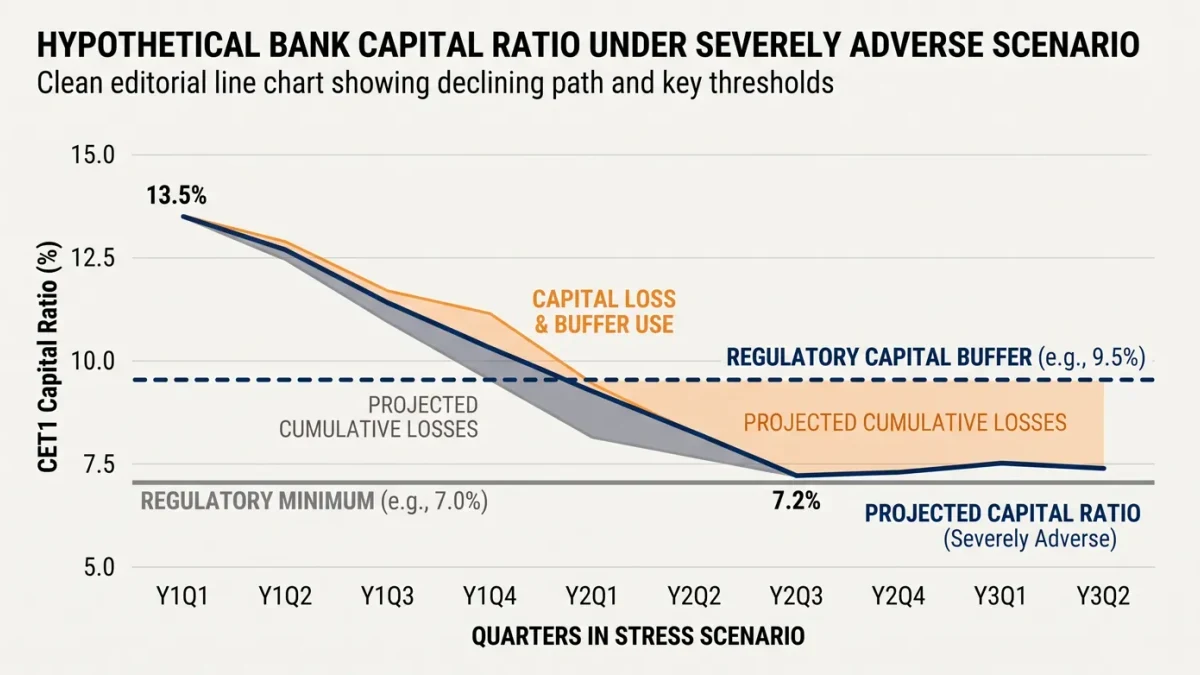
Not cash in a vault — an accounting buffer. Capital is the difference between a bank's assets and its liabilities: the slice of the balance sheet funded by equity rather than borrowing, available to absorb losses before any creditor is touched. A bank with a hundred dollars of loans funded by ninety-two of deposits and debt and eight of equity can lose eight dollars before insolvency; the ninth dollar of losses hits depositors. The CET1 ratio expresses that buffer against risk-weighted assets — loans and securities scaled by regulatory risk factors, so a mortgage portfolio carries less weight than unsecured credit cards. The ratio's two moving parts matter: banks have raised capital by retaining earnings (numerator) and by growing assets (denominator), and post-2008 regulations forced the largest U.S. banks from roughly seven percent CET1 before the crisis to around twelve percent in the 2020s, per Federal Reserve data — a structural strengthening the 2020s' stress episodes validated.
What sits on top of the minimum?
Layers, each with a logic. The regulatory minimums — 4.5 percent CET1 under the Basel framework — are a floor no large bank approaches. Above it: the capital conservation buffer; the stress capital buffer, set annually by the Federal Reserve's stress test results, scaling with each firm's projected losses under the Fed's severe scenario, as this publication's coverage of the 2026 results details; the global systemically important bank surcharge, rising with each bank's size and interconnectedness; and the countercyclical buffer, set at zero in the United States but available as a tool. The stacking produces the binding requirement each bank must exceed to pay dividends freely — breach the buffer stack and payout restrictions engage automatically. The design intent is graduated: banks dip into buffers in stress by design, with penalties that pre-commit them to rebuild.
What is Basel III's 'endgame' debate about?
How much capital is enough — the decade's most contested bank-regulation question. The Basel III framework finalized internationally after 2008 was only partially implemented in the United States; the unfinished piece — the "endgame" proposal — would expand risk-weighting to more of the trading book and operational risk. The U.S. proposal issued in 2023 would have raised large banks' requirements by roughly sixteen to nineteen percent by the agencies' own estimates, drawing a bank-industry campaign of biblical intensity; a 2024 re-proposal scaled the increase back materially, and the rule's fate remained contested into 2025-2026, per the agencies' public dockets. The technical substance — whether trading risk is properly measured, whether operational risk capital punishes scale — is genuine; so is the distributive question, since every point of required capital is a point of lending return shifted from shareholders to safety. The 2025-2026 recalibration of the supplementary leverage ratio, covered in this publication's Treasury-liquidity analysis, is the same debate conducted through a different instrument.
What did the failures of 2023 test?
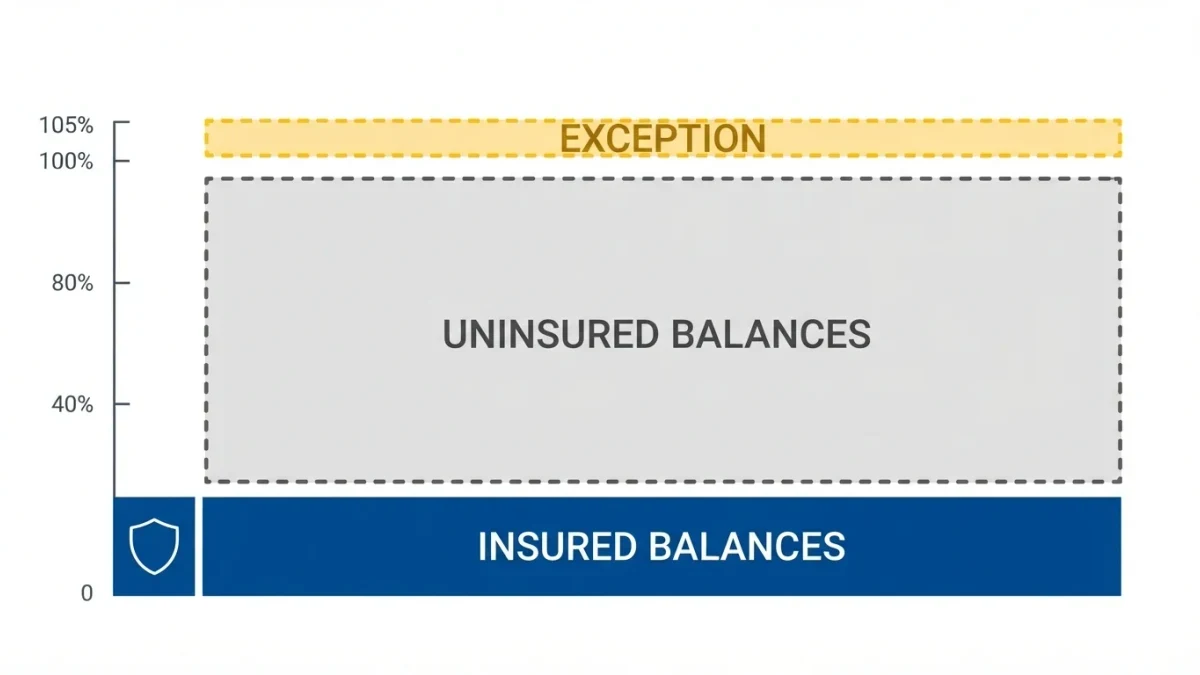
The system's edge cases, and the answers were mixed. Silicon Valley Bank, Signature, and First Republic held CET1 ratios that satisfied their requirements — capital was not the proximate cause; interest-rate risk on securities portfolios and uninsured-depositor runs were, per the Federal Reserve's own post-mortems. The episode exposed a measurement gap: securities marked to market had shrunk true economic capital faster than the regulatory ratio showed, and the deposit run outran any capital cushion's absorption timeline — capital absorbs solvency losses slowly, while liquidity runs kill in days. The policy responses — stronger liquidity rules, the long-term debt requirement for large regionals proposed afterward, supervision reforms — targeted exactly those gaps, per the agencies' proposals. The honest lesson cuts both ways: capital requirements worked as designed for the failures they were designed for; the 2023 failures came through doors the capital frame did not cover, and regulation has been adding doors.
What is the leverage ratio's role beside risk weights?
A backstop with a different philosophy. The supplementary leverage ratio ignores risk weights entirely: capital as a flat percentage of all assets, however safe. Its purpose is humility — risk-weight models can be wrong, and the 2008 crisis found the models wrong precisely where they were most confident, in structured securities. The cost is bluntness: charging the same capital for a Treasury as for an unsecured loan pushes banks away from exactly the safest assets, which is why the 2025 recalibration debate — adjusting SLR to let banks intermediate more Treasuries — runs directly against the backstop's original logic. The two instruments embody a permanent tension: risk-sensitivity rewards modeling skill; leverage floors punish it. Modern regulation uses both, and every calibration argument is an argument about which error to prefer.
How do requirements shape bank behavior?
Through the arithmetic every bank manager runs daily. Every asset consumes capital at its risk weight, so pricing any loan must clear a return-on-equity hurdle set by the requirement — which shifts lending toward light-touch assets: Treasuries, agency mortgages, prime corporates. High requirements raise the hurdle on every lending decision, a mechanism industry studies credit with real employment effects on credit supply, particularly to mid-sized borrowers whose risk weights are heaviest. The same arithmetic pushes activity into less-regulated vessels — private credit funds, direct lenders — where no CET1 applies, as this publication's private-credit analysis covered: regulation's shadow moves activity as surely as it constrains it. None of these effects argues the requirements are wrong; all of them belong in an honest account of what the rules do beyond safety.
Why do investors watch capital ratios?
Because the ratio bounds both resilience and returns. A bank's CET1 above requirements is capacity: headroom for dividends, buybacks, and loan growth, which is why banks publish their management targets alongside the regulatory stack, and why payout announcements follow stress-test results each summer. A ratio drifting toward requirements is a constraint story: growth slows or capital raises loom. Return on equity against the requirement sets the valuation frame — banks earning mid-teens returns on twelve percent capital are compounding machines; banks earning their cost of capital are leveraged bond portfolios with branches. The numbers publish quarterly in every large bank's release, standardized across the industry, which makes ratio-watching one of the cleanest comparative disciplines in financial analysis.
What is the disciplined verdict on the framework?
That capital requirements are the load-bearing wall of modern banking, built sturdier after 2008 and validated by every stress since — and that they are one wall, not the building. Liquidity, supervision, resolution, and deposit insurance each carry their own weight, and each failure era teaches which wall was thin. The 2020s left the largest U.S. banks with roughly twelve percent CET1, thick buffers, and a regulatory argument still running about whether the floor should rise further — a debate readers can follow in the agencies' dockets, where every number in this article traces to a public document.
The verdict also carries a scale note: capital cannot be judged in isolation from what sits beside it. Twelve percent CET1 with thin liquidity supervision is a different building from twelve percent with strong liquidity floors, resolution plans, and stress tests calibrated to actual portfolios. The framework's defenders and critics both make strongest cases when they quote one wall at a time; the reader holding the whole floor plan is harder to persuade, which is the point of the floor plan.
Where can readers verify the numbers?
Every large bank's CET1 ratio publishes quarterly in its earnings release and 10-Q; the Federal Reserve publishes system-wide capital data, stress-test results, and the rulemaking dockets; the Basel framework documents sit on the Bank for International Settlements' site. The whole capital architecture is public — which is fitting, since its entire purpose is to make each bank's capacity to absorb losses visible to anyone who looks.