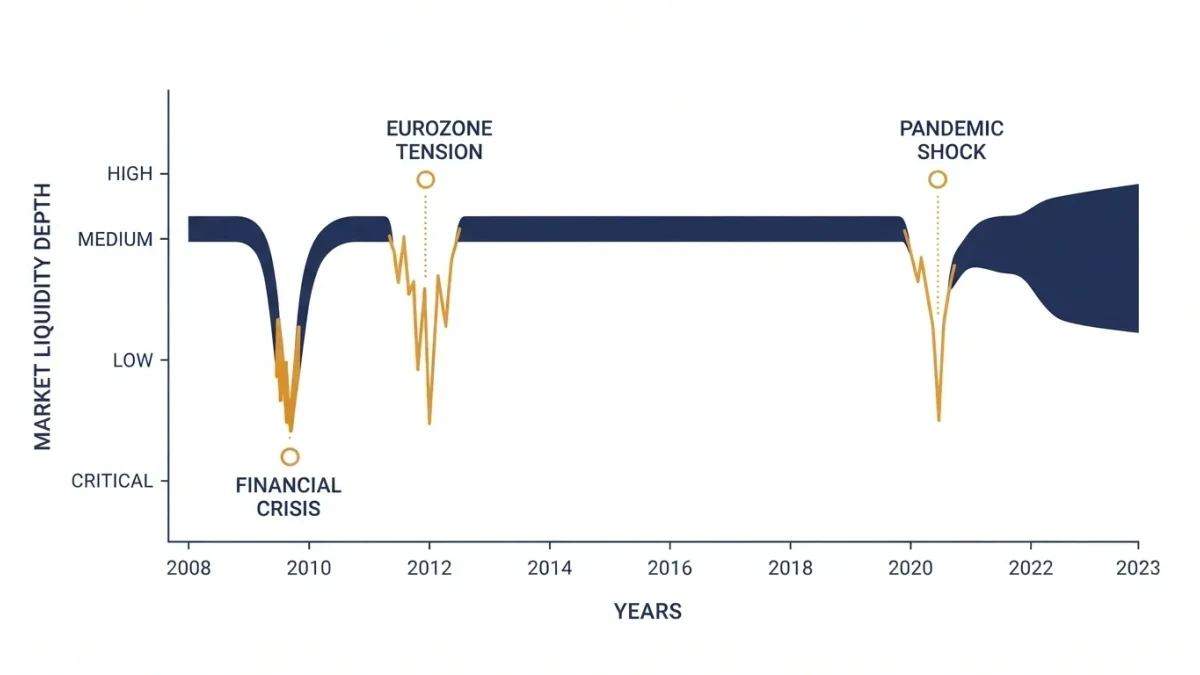
The market for U.S. Treasury securities — more than twenty-eight trillion dollars in marketable debt outstanding, per Treasury data — has suffered three visible liquidity breaks since 2019: the September 2019 repo spike, the March 2020 dash-for-cash, and the autumn 2023 yield dislocation that accompanied a near-record pace of issuance. The world's safest asset has become the system's most watched fragility. Market Today publishes information, not investment advice, and this analysis reads the plumbing, not the level of yields.
What does 'liquidity' mean in the Treasury market?
The ability to trade size, quickly, near fair value, without moving the price. It is measured in bid-ask spreads, order-book depth, and the cost of immediate execution — metrics that deteriorate sharply in stress. Two decades ago, human dealers at the big banks warehoused risk and made markets from inventory; today, high-speed electronic intermediaries supply most of the visible depth but hold positions for seconds, while the banks' market-making capacity is constrained by post-crisis capital rules. The result, documented in Federal Reserve staff research, is a market that is deep in calm and shallow in stress: liquidity that is rented, not owned, evaporates exactly when it is needed most.
What happened in the three episodes?
Three different failures of the same plumbing. In September 2019, overnight repo rates spiked above ten percent for days when bank reserves grew scarce against settlement demands — a payments-system jam, cured by months of central-bank liquidity injections, per New York Fed operations records. In March 2020, the pandemic dash-for-cash saw investors sell even Treasuries for dollars, spreads blew out, and the Federal Reserve intervened with purchases at a pace of tens of billions weekly — the buyer of last resort for its own government's debt. In autumn 2023, growing issuance met a price-sensitive buyer base; the 10-year yield touched five percent, term premium reawakened, and the Treasury Borrowing Advisory Committee's deliberations (disclosed in official minutes) prompted a shift toward shorter maturities to stabilize demand.
Who actually holds this market now?
A coalition with unlike mandates, which is the structural novelty. Foreign official holders — historically the price-insensitive backbone — have plateaued near seven trillion dollars in aggregate for years, per Treasury TIC data. The Fed itself, once the largest marginal buyer, has been letting holdings run off under balance-sheet reduction since 2022. Into the gap came hedge funds running the cash-futures basis trade — positions the Federal Reserve's financial stability reports have sized around a trillion dollars in repo-financed holdings — plus households, money funds, and bond dealers. The new buyers are fast-money and leveraged rather than patient, so the market's marginal bid now depends on financing conditions in repo markets. Stability was exchanged for responsiveness.
The composition shift matters because it changed what a "seller of Treasuries" means. When a foreign central bank trimmed holdings in the old market, the position moved into patient hands at a stable price; when a leveraged fund unwinds today, the selling arrives with its financing attached — repo recalls, margin calls, and futures liquidation compounding the same directional move. The instrument is unchanged; the physics of its ownership is not.
What have regulators actually done?
A sequence of plumbing repairs, each traceable to a published document. The SEC finalized rules in late 2023 requiring central clearing of Treasury transactions, with compliance phased toward 2026 — extending clearing to a market that had resisted it for decades. The Federal Reserve made its Standing Repo Facility permanent plumbing in 2021 precisely to cap repo spikes like 2019's, and in 2025 it proposed recalibrating the supplementary leverage ratio so banks can intermediate more Treasuries without regulatory penalty, per its June 2025 proposal. The Treasury itself adjusted issuance composition after the 2023 episode. The pattern is consistent: each break produced a specific repair, listed in official notices, none of which claims to abolish the next break.
Is the hedge fund basis trade the fuse regulators fear?
It is the named candidate in every official report, and honesty requires quoting its mechanics. Funds buy cash Treasuries, sell futures, and finance the position in repo; the position is small per-trade but enormous in aggregate, and it is leveraged on short-term borrowing — the same architecture that unwound violently in March 2020, when basis positions amplified the Treasury selloff until the Fed backstopped the market. The Fed's stability reports have flagged dealer capacity to absorb a rapid unwind as a vulnerability repeatedly since 2022. The counterpoint: futures-market margin calls force losses to be recognized continuously, and clearing centralizes counterparty risk. The honest summary is that the trade is monitored, named, and unresolved — a known channel of contagion without a known probability.
What should readers watch?
Four indicators, all public: repo rates and Standing Repo Facility usage (weekly Fed data) for funding stress; bid-ask spreads and market depth statistics for trading stress; the Treasury's quarterly refunding announcements for supply design; and the leverage ratio rulemaking's progress for dealer capacity. None predicts a break; together they are the dashboard regulators themselves read. The evidence since 2019 supports neither panic nor complacency — it supports supervision, which is exactly what the world's most important market now receives.
One number frames the stakes better than any prose: Treasury marketable debt has roughly doubled over the past decade while dealer balance-sheet capacity has not, per Fed research. More paper through the same corridor is a design problem before it is a crisis — and design problems, unlike crises, respond to scheduling.
Where can readers verify all of this?
Treasury publishes debt and TIC data, the Fed publishes operations data and financial stability reports, and the SEC's clearing rules are in the Federal Register. Every claim above sits in those public records, and the dashboard takes a bookmark folder, not a Bloomberg terminal.