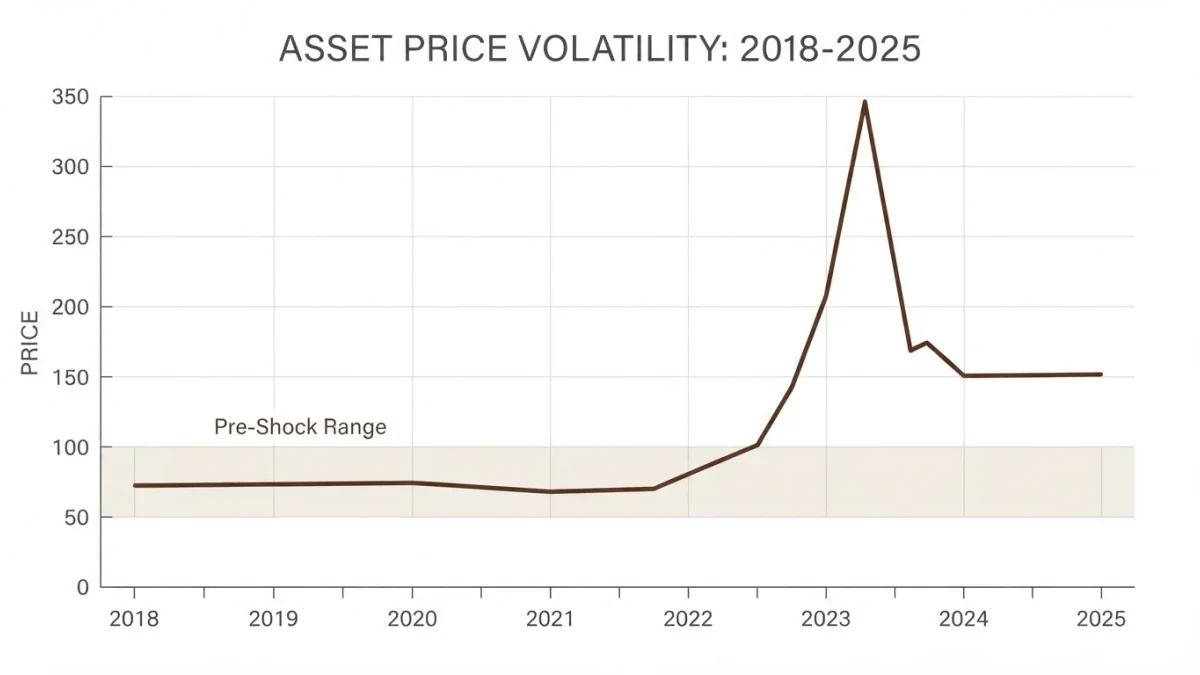
Cocoa futures in New York traded near three thousand dollars a metric ton entering 2023 and peaked above eleven thousand in late 2024 — an event without precedent in the market's history, exceeding even the 1970s shocks in real terms, per exchange price records — before collapsing by more than half through 2025 as West African supply recovered. A single soft commodity's round trip, fully documented, is the best available seminar on how agricultural markets behave when weather, disease, and government policy collide with inelastic demand. Market Today publishes information, not investment advice; this is the anatomy.
What started the cocoa shock?
Crop failure in the two countries that grow most of the world's cocoa. Côte d'Ivoire and Ghana together produce roughly sixty percent of global cocoa, and the 2023-24 harvest collapsed under a combination long in the making: heavy rains followed by dry harmattan winds at flowering, black-pod disease and swollen-shoot virus thriving in the wet weather, chronic underinvestment in aging trees, and fertilizer scarcity after global prices rose. Crop arrivals at West African ports ran far below prior-year levels through the season, per monitoring data, and grindings — the processing that reveals true availability — fell in consuming regions as beans became scarce. The market had entered the season with already-thin stocks after two mediocre harvests; there was no buffer.
Why did prices rise so violently?
Because demand for chocolate does not stop quickly, and speculative positioning accelerated the move. Cocoa demand is among the least elastic in commodities: manufacturers reformulate slowly, contracts cover months ahead, and consumers absorb price increases grudgingly but substantially. With supply suddenly down by double-digit percentages and stocks near minimums, the price had to rise until something gave — and the adjustment took the market from three thousand to eleven thousand dollars before demand destruction and supply recovery arrived. Along the way, exchange mechanics added fuel: margin requirements on a fast-rising contract forced short covering, and by early 2024 open interest told the story of hedge funds and trade houses crowded onto both sides of a thin market. Squeezes in London and New York left chocolate makers short physical beans — several European processors halted lines rather than pay spot prices, per industry reports.
What role did West African policy play?
A central one, and the episode is a case study in regulatory amplification. Both producer countries set farm-gate prices annually through marketing boards — Ghana's Cocoa Board and its Ivorian counterpart, joined in a producer-pact framework meant to coordinate pricing and capture more value. Fixed farm-gate prices below world market levels during the boom meant farmers did not receive the rally's full signal to rehabilitate farms or invest in inputs — weakening the supply response — while smuggling across the border toward whichever country paid more distorted official arrivals data. Meanwhile the producer countries' coordinated attempts to withhold supply or demand premiums ran into the reality that their shared crop failure left them with little to withhold. Policy meant to stabilize ended up blunting the price signal and extending the imbalance — a soft-commodity pattern with a long history.
How did the market finally rebalance?
Through both channels of the classic cure: higher prices destroying demand and calling forth supply. On the demand side, manufacturers reformulated — smaller portions, more fillers and non-cocoa fats where regulations allowed, overt price increases — and global grindings fell for consecutive quarters, per grind data. On the supply side, the 2024-25 season recovered: weather normalized, farm-gate prices were raised sharply to encourage delivery, and neighboring countries' output — Cameroon, Nigeria, Ecuador, Brazil — expanded at the margins where trees respond fastest. New York futures fell from above eleven thousand toward the mid-thousands during 2025, per exchange data — still roughly double pre-shock levels, with the market now debating how much of the higher floor is structural cost versus lingering tightness. The shape of the cure — prices high until both sides answer — is the commodity market working, painfully, as designed.
What does the episode teach about soft commodities generally?
Five durable lessons, each visible in this single episode. First, geographic concentration is the master risk: two countries, sixty percent of supply, one weather system. Second, perennial crops cannot respond fast — a cocoa tree takes three to five years from planting to production, so the supply response is measured in seasons, not months. Third, government price administration in producing countries routinely distorts the signals that would otherwise balance the market. Fourth, inelastic demand makes the price do the adjusting, violently, until reformulation catches up. Fifth, financial positioning — trend-following funds, squeezed shorts — amplifies both directions without changing the destination. Every soft-commodity shock on record — coffee frosts, orange freezes, sugar cycles — runs the same five-part script with local variations.
What did the exchanges and regulators do during the shock?
Market infrastructure bent visibly under the strain, which is itself instructive. Both London and New York exchanges adjusted margin and position-reporting rules repeatedly as prices climbed — margin calls on a contract multiplying in months stressed processors and speculators alike, and at the peak some trade houses reportedly struggled to finance hedge positions that had moved sharply against them. Regulators scrutinized concentrated positioning; the exchanges considered and adjusted delivery mechanics as scarce physical beans made delivery itself contentious. None of this caused the shock — weather and disease did — but the plumbing episodes explain how a physical shortfall becomes a financial event, and why post-mortems of such episodes read half like agronomy and half like a clearinghouse manual.
How do chocolate prices relate to cocoa prices?
With a lag and a dampener that consumers feel directly. Cocoa beans are one input among many in a finished chocolate product — sugar, milk, energy, packaging, labor, marketing — so even a quadrupled bean price arrives at the retail shelf as a substantially smaller percentage increase, spread over quarters as manufacturers work through hedges and contracts. The 2023-2025 shock followed the pattern: retail chocolate prices rose cumulatively by double digits across 2024-2025 in U.S. and European data — the largest sustained increase in decades — but far less than the bean market's multiple. The dampening works both ways: when beans collapsed in 2025, shelf prices did not fall proportionately, because menu costs, wages, and reformulated recipes ratchet. Commodity shocks arrive at the consumer as smoothed, sticky versions of themselves.
Where does the cocoa market go from here?
The honest answer is structured uncertainty, and the structure is worth naming. On the bear side: high prices have improved farm-gate economics, rehab investment is rising, Ecuador and Brazil are expanding aggressively, and grind data shows demand destruction that will not reverse fully even at lower prices. On the bull side: the West African tree stock is aging and disease-ridden, structural underinvestment takes years to reverse, and the producing countries' policy apparatus stands ready to disrupt flows again. What the evidence supports is neither a return to the old three-thousand-dollar world as if nothing happened nor a permanent eleven-thousand world — but a regime of higher volatility around a floor set by genuine West African cost inflation, with weather as the recurring wildcard. Forecasters who claim more precision than that are claiming more than the data contains.
How should readers track soft commodities after this episode?
With the instruments the episode itself validated: port arrival and grind statistics for supply truth; exchange inventories and spreads for tightness; the futures curve's shape for the market's own expectations; producer-country policy announcements for the political layer; and, above all for perennials, the state of the tree stock — investment, disease, age — which moves slower than any price but governs all of them. Soft commodities punish those who trade the chart and reward those who read the crop; the cocoa shock repriced that lesson above eleven thousand dollars a ton, and the tuition was paid publicly.
Where can readers verify the numbers?
Exchange price records quote the full round trip; grind statistics publish from processing associations on both sides of the Atlantic; producer-country marketing boards publish crop and pricing data; and the U.N. food agency tracks the food-price layer. The primary documentation of this shock is unusually complete, and a reader who reconstructs it from these sources will hold the working model for every soft-commodity cycle to come.