OPEC+ countries supply roughly forty percent of the world's crude oil and hold nearly all of its spare production capacity, per U.S. Energy Information Administration assessments — which is why each of the group's Vienna meetings can add or subtract millions of barrels per day from global supply on a calendar the market memorizes. The machinery underneath — quotas, voluntary cuts, compensation schedules — is more improvised than the communiqués suggest.
What is OPEC, and what is the plus?
The Organization of the Petroleum Exporting Countries, founded in Baghdad in 1960, is a group of oil-exporting governments that coordinates production to manage prices — a cartel in economic terms, though members reject the word. The "plus" arrived in 2016, when OPEC proper and ten non-members led by Russia formed the Declaration of Cooperation, creating the wider group that sets quotas today: the original members plus Russia, Kazakhstan, Mexico, Malaysia, and other producers. Membership shifts at the margins — Angola left in early 2024 — and decisions formally require consensus, which means the group moves at the speed of its most reluctant member. The group's full ministerial meetings set the framework; a smaller joint ministerial monitoring committee meets more often and often decides in practice, usually by video with short notice — a format that has itself become a price-moving variable.
How is a quota deal actually structured?
As a table of country-level production targets, negotiated politically, against a baseline. Each country is assigned a ceiling in barrels per day for crude; the sum across countries equals the group's agreed total. The tables are public in broad outline — the EIA and the group's own releases publish reference production levels — but the diplomacy behind them is the substance: members bargain over baselines that reflect ambition as much as capacity, and a country's quota is partly a statement of status. When the group cut 9.7 million barrels per day in April 2020 — the largest coordinated reduction ever agreed, in response to pandemic demand collapse — the table divided the pain according to those negotiated baselines, and the unwinding of that cut shaped the following three years of oil markets.
What are the 'voluntary' cuts layered on top?
The 2020s' signature improvisation. Beginning in late 2022, eight members — Saudi Arabia and Russia at the center — announced additional "voluntary" cuts on top of their formal quotas, eventually stacking roughly 2.2 million barrels per day of extra reductions by 2024, per the group's statements. The device solved a political problem: formal quota reallocation would have reopened every member's baseline, so the eight simply pledged separately. The cost was architectural — voluntary pledges bind loosely, apply unevenly, and in 2025 became the layer the group chose to unwind first, starting with a first tranche in April 2025 and proceeding in monthly increments that were paused and resumed as prices dictated, per meeting statements. When you read that "OPEC+ is restoring supply," it is almost always these voluntary barrels returning, not the formal quotas changing.
How does enforcement actually happen?
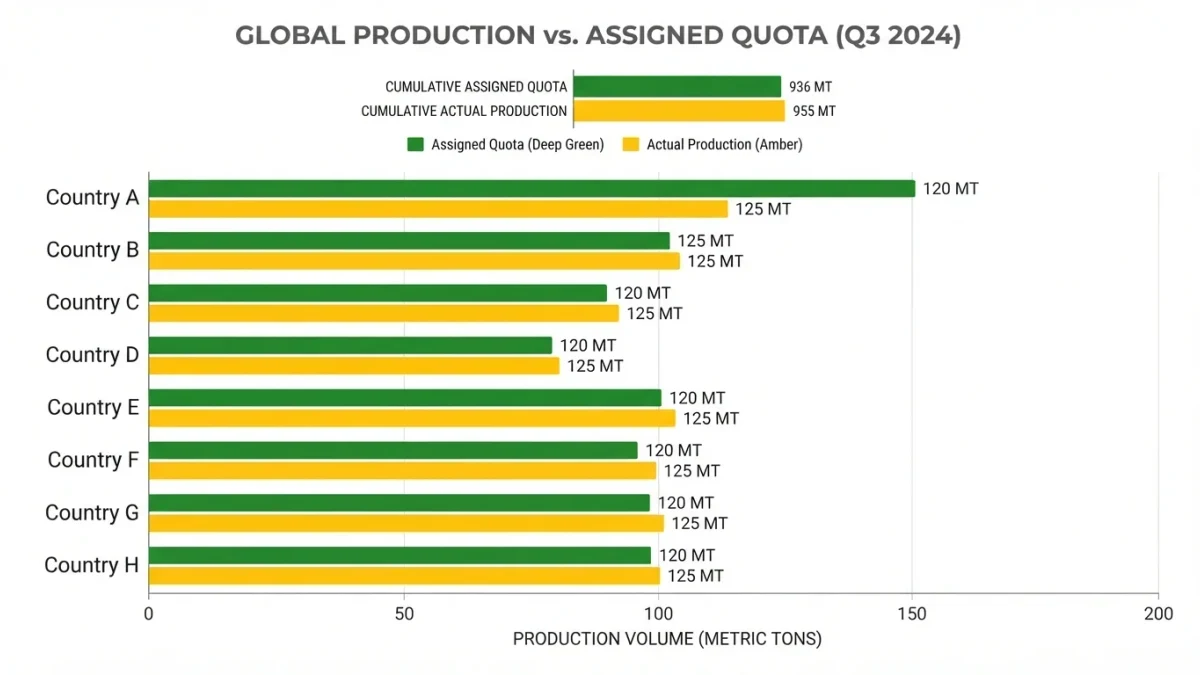
Through compensation schedules, mild compared with enforcement in most cartels. Members that produce above quota — as several did repeatedly, notably during 2020-2024 — are not fined; they are asked to submit plans to "compensate" by producing below quota in later months, and the secretariat publishes the running tally. The mechanism relies on the two giants' self-interest: Saudi Arabia, which anchors the cuts with the deepest reductions and the most spare capacity, tolerates others' overproduction up to the point where its patience is itself a bargaining chip. In 2025 the group leaned harder on laggards, publicizing compensation schedules for countries including Kazakhstan and Iraq after repeated overproduction, per official statements — discipline by naming, backed by the implicit threat that the whole edifice, and everyone's revenue, depends on the Saudis' continued willingness to shoulder the burden.
What is spare capacity and why does it matter more than quotas?
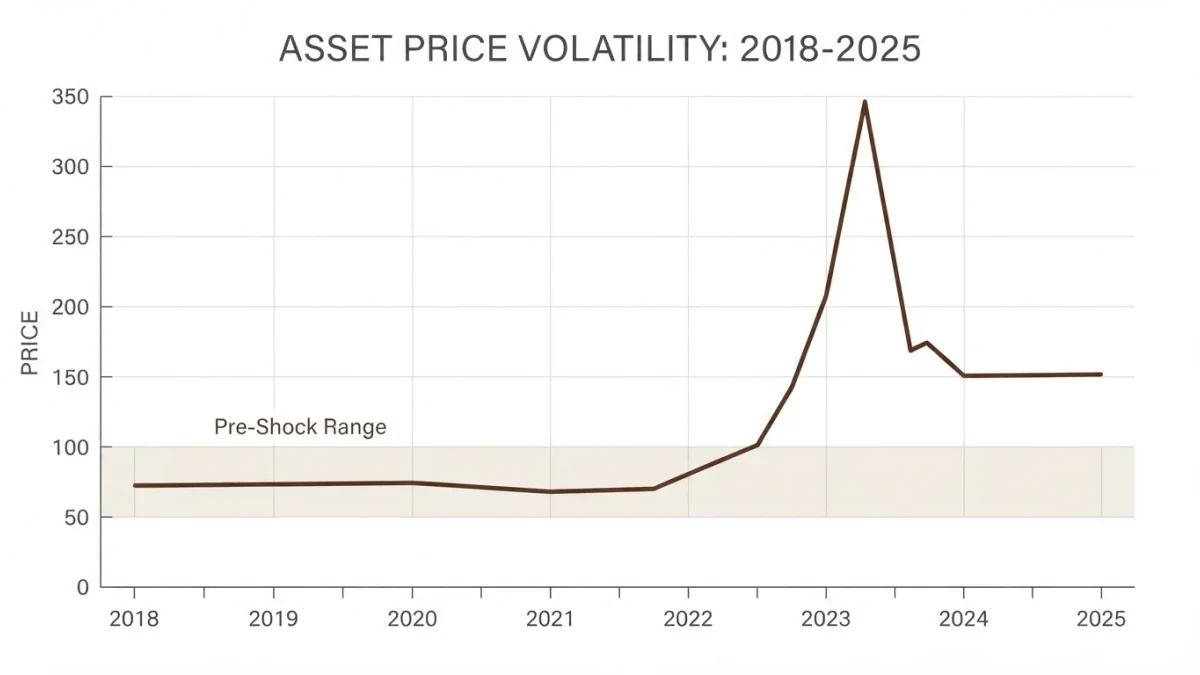
Spare capacity — production that can be activated within months — is the group's real power, and it is concentrated overwhelmingly in Saudi Arabia and, to a lesser degree, the United Arab Emirates, per EIA assessments. Total OPEC+ spare capacity has run in the range of several million barrels per day in recent years, against a world market near one hundred and three million. This buffer is what regulators and importers actually watch: it is the insurance policy against supply shocks elsewhere — war, sanctions, accidents — and when spare capacity itself is disrupted, prices respond violently. The June 2025 Israel-Iran conflict offered the live demonstration: strikes near Iranian energy infrastructure lifted Brent by double digits in days, per market data, precisely because the market priced the risk to both Iranian supply and the Gulf capacity that anchors the world's buffer, before a ceasefire brought the premium back down.
How do quota decisions reach the oil price?
Through an expectations channel that operates on three clocks. The fastest is the surprise: meeting outcomes leaked or announced against expectations — the April 2023 surprise cut of over a million barrels per day lifted Brent by six percent in a day, per exchange data. The middle clock is the calendar: since 2023 the group has often announced decisions to pause or proceed with supply increases weeks ahead of actual barrel movement, letting the market pre-price policy. The slowest is compliance: announced cuts that members fail to deliver leak barrels back into the market, and tanker-tracking data — which the EIA and commercial services publish — frequently shows group production above its stated ceiling. Reading OPEC+ therefore means reading three documents together: the communiqué, the calendar of future increments, and the monthly production estimates.
When has the system failed or fractured?
Twice memorably, both times with price collapse. In 2014, the group declined to cut against rising American shale output, choosing to defend market share; prices fell by more than half within two years, and the episode ended in the 2016 cooperation deal that created the plus. In March 2020, a Russian-Saudi dispute over additional pandemic cuts dissolved the agreement entirely; the price war that followed, landing in the same weeks as pandemic lockdowns, briefly took U.S. crude prices negative before the record April 2020 cut restored the pact. The lesson both times: the cartel's discipline holds while the dominant members' interests align, and the alignment is economic, not sentimental — the group tolerates lower prices longer than analysts expect when market share is at stake.
Fracture risk also runs through domestic politics rather than meeting rooms. Several members depend on oil revenue to fund state budgets — fiscal break-even prices estimated well above market levels for several producers, per EIA and IMF assessments — and cash-strapped members cheat first. The cartel's history is a ledger of this tension: discipline erodes slowly through small overproductions, then repairs suddenly after a crisis forces renegotiation. The 2020s' compensation-schedule era is best read as an ongoing experiment in keeping the slow erosion from reaching the sudden-repair stage.
How should a reader follow OPEC+ without drowning?
A small stack of sources suffices. The group's post-meeting statements, published on its site, are the record of record; the EIA's Short-Term Energy Outlook translates quota decisions into supply forecasts monthly; tanker-tracking summaries in EIA and press coverage expose the compliance gap; and the meeting calendar — published, when it is published — sets the surprise schedule. The disciplined habit is separating the three clocks: what was decided, when barrels actually move, and whether the barrels show up in production data. Communique headlines collapse those into one; careful readers do not.
One more distinction repays the effort: the group's decisions shift supply, but prices also carry a premium for decision risk itself — the possibility that a meeting ends without agreement. Days before major meetings, that premium often builds; minutes after decisions land, it unwinds regardless of direction. Watching options-market pricing around meeting dates makes this visible, and it explains why sometimes the cleanest market moves come when OPEC+ does precisely nothing, loudly.
Where can readers verify the claims?
The EIA publishes OPEC production, spare capacity estimates, and the Short-Term Energy Outlook free on its site, including its assessment of revenue effects on member governments. The group's own releases and meeting archives are public. As throughout this series, the primary documents are accessible, and an hour a month with them outperforms reaction coverage at any price.