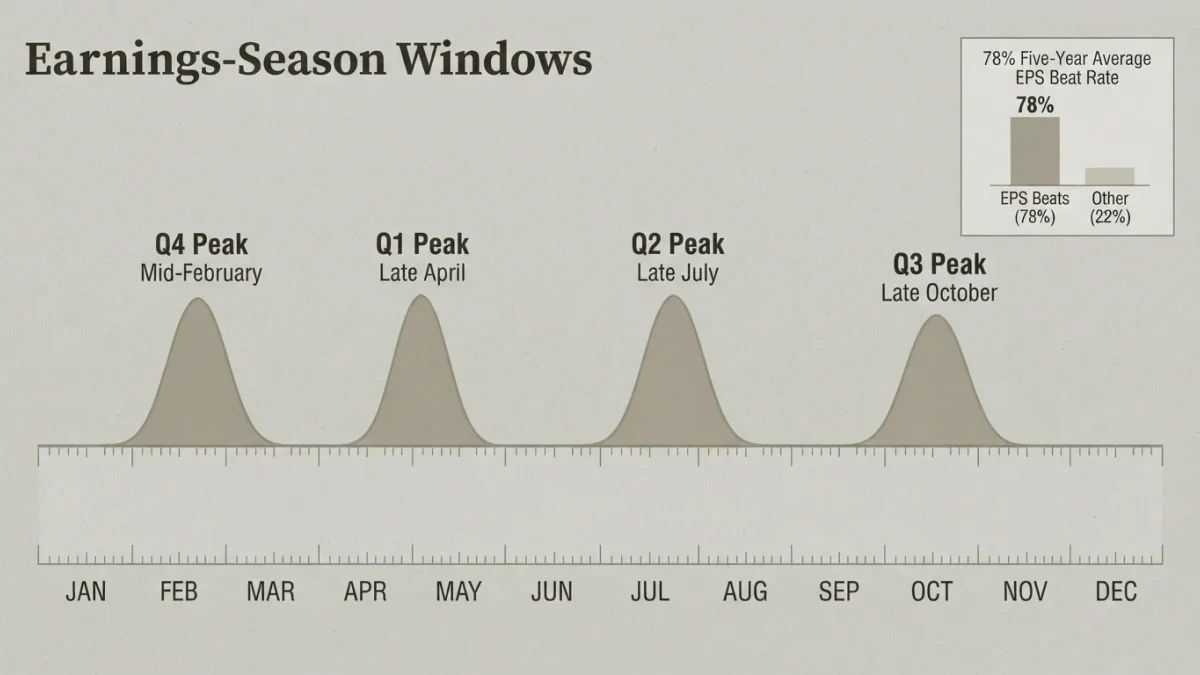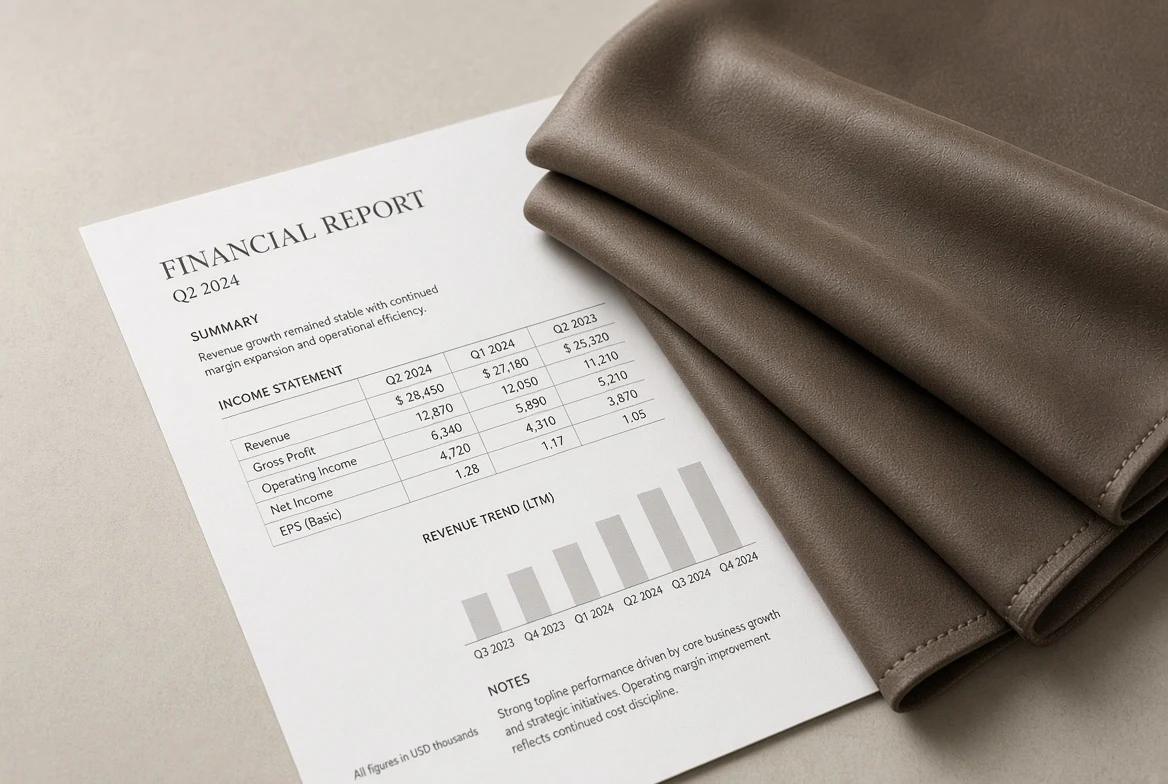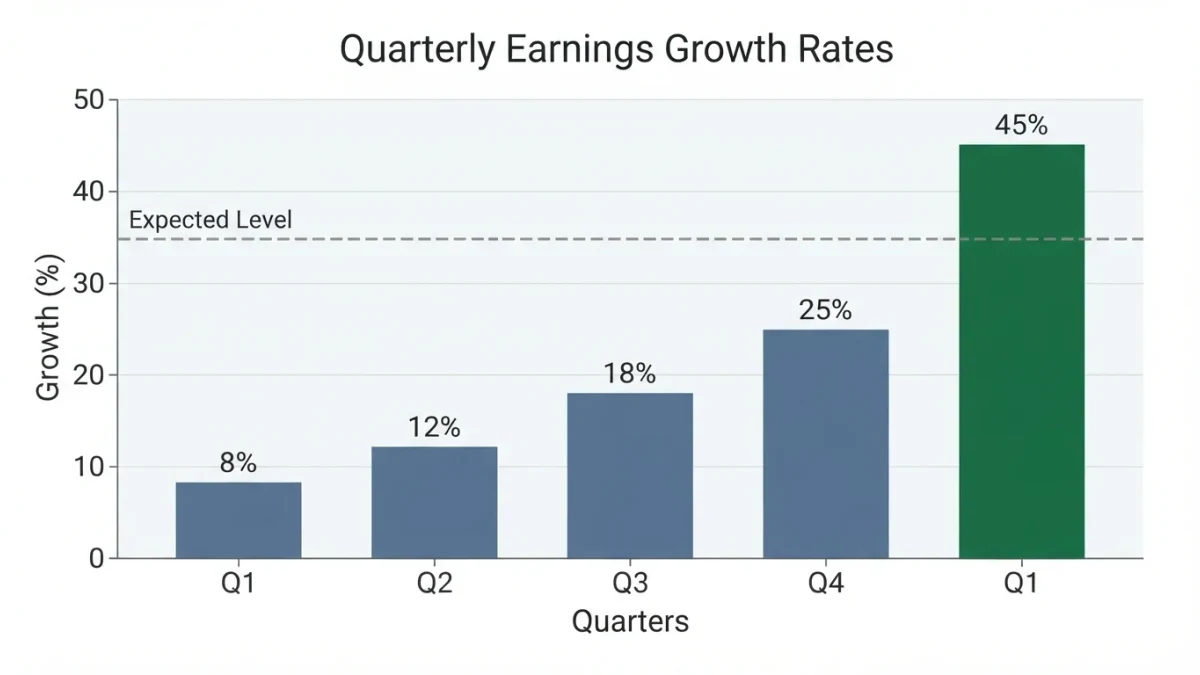

Each earnings season follows the same choreography: large banks report in the second full week after the quarter closes, the flood peaks two weeks later with hundreds of reports a day, and the mega-cap technology names close the show three to four weeks in — by which point roughly a third of the S&P 500's market value has still not reported, per season-completion statistics published by the tally services. The calendar is public, predictable, and more informative than its reputation as trivia.
Why does the season start with banks?
Filing deadlines and fiscal calendars, with an information dividend. The Securities and Exchange Commission requires quarterly reports — Form 10-Q, or the 10-K for fourth quarters — on deadlines scaled to company size: large accelerated filers get forty days after quarter-end for 10-Qs, sixty for the annual 10-K, per SEC rules. Banks close their books on the calendar quarter and move fastest to report, in mid-January, mid-April, mid-July, and mid-October — and as this publication's coverage of the January 2026 bank open detailed, their results carry macro signal beyond their own shareholders: net interest income reads the rate environment, credit costs read household balance sheets, trading and advisory read market activity. The season's first week is therefore a macro preview before the single-name flood.
The order also disciplines narrative hygiene: any summary of "the season" written in its first half is a summary of a minority of the evidence — a fact worth remembering every quarter, because the season's early verdicts get the headlines and its final week gets the corrections.
What drives the timing of everyone else?
Deadline arithmetic plus convention. Every company must file within its deadline, but most report earnings by press release and call one to three weeks before the filing — dates chosen by convention: companies anchor to the same weeks each year (retailers report Thursday mornings, historically, because weekends are their data-complete point), industries cluster (semiconductors bunch in the season's back half), and each company avoids colliding with its own sector's giants to preserve analyst attention. The result is a stable season shape: a bank-led week one, a broad flood in weeks two and three, a technology finale in weeks three and four, and a long tail of smaller and fiscal-year outliers stretching a month beyond. The shape repeats so reliably that deviations themselves are information — a company that suddenly moves its report date earlier or later usually has a reason, and the reasons trend toward the unwelcome.
Why do the biggest tech names report last?
Fiscal calendars and complexity. The mega-cap software and hardware companies run October fiscal year-ends or complex multi-segment closes that take longer to finalize, and by convention they report in the season's final week — the cluster that traders simply call "the Magnificent earnings" in the 2020s. The ordering concentrates the season's information value late: the largest earnings contributors to the index, with the most read-through to other stocks — semiconductor supply chains, cloud spending, advertising markets — resolve after most of the market has already printed. A season's verdict is therefore never complete until its last week, a fact that frustrates mid-season narratives written after week two, when the index is half-reported by count but barely a quarter reported by weight.
What are the ritual mechanics of a report?
A standardized theater. Most companies release results after the close or before the open — the two windows chosen so that the mandatory conference call can bracket trading hours. The release carries the statements, the reconciliation tables, and usually guidance; the call, run under fair-disclosure rules, gives prepared remarks from the chief executive and finance chief followed by analyst questions; the transcript publishes within hours through the services that track them. The sequence matters for readers: the release is the legally framed document, the call is where tone lives, and the question-and-answer — unscripted, less lawyered — is historically where the informative slips occur — executives rehearse the prepared remarks and improvise only under questioning, which is why transcript readers mark the Q&A sessions first. The pre-announcement channel completes the ritual: companies whose results will deviate materially from expectations often warn days or weeks early, which is why sudden large moves sometimes arrive before the scheduled date.
How should a reader use the calendar strategically?
- Mark the bank week as macro week: rate and credit read-through arrives before the flood.
- Note the sector clusters — retail in the season's second half for fourth-quarter reports, semiconductors in the back half always — and read the first reporters in each cluster as read-throughs for the rest.
- Circle the mega-cap finale dates: single evenings that reprice entire themes, and the options market prices them in advance.
- Track completion by weight, not count: "most companies have reported" is a true statement at a moment when most market value has not.
- Watch the date-change feed: moved reports are weak-hand tells, and the aggregation services publish the changes.
What did the 2020s change about the calendar?
Less than expected, which is itself the finding. The pandemic threatened to scramble reporting seasons — deadlines were formally extended by the SEC in 2020 — but the season shape snapped back and held: banks still open, clusters still cluster, the technology finale still closes. Two durable changes did land. Volatility became scheduled: event-driven options markets now price each mega-cap report as a named event, concentrating hedging demand on known dates, as this publication's options analysis covered. And the pre-announcement culture strengthened: after the 2020 shock, companies learned that warning early is punished less than surprising late, so the information mix shifted modestly from report-day to pre-report — the calendar grew a prologue.
What is whisper-week positioning?
The calendar's last stretch before each report has its own micro-climate. As dates approach, options-implied moves publish for every name, telling the market what size reaction is priced; estimate revisions slow as analysts lock forecasts; and positioning data shows whether the fast money is leaning with or against the expected surprise. This pre-report week is where expectations harden — and where a reader can locate genuine information asymmetry, since the implied move versus the historical average move on that name reveals whether the market considers the upcoming report unusually risky. The calendar, used this way, is not just a list of dates but a schedule of risk concentration, with each marked day carrying its own pre-priced weather.
What is the season's afterlife?
The part most coverage skips. After the last report, two slower processes digest the season: estimate revisions propagate through analyst models for weeks, resetting the expectations base the next season will be graded against; and filings — the 10-Qs and 10-Ks with the full statements, notes, and auditor sign-offs — complete for weeks after the headline event, containing the detail that earnings-day coverage could not wait for. Readers who return to the filings after the noise gets the season's most complete document at the moment attention is cheapest. The afterlife is where the record becomes permanent; the earnings call is where it becomes quotable.
Where can readers get the calendar itself?
The earnings calendar is public through the exchanges, the tally services that track report dates and completions, and each company's investor-relations page; SEC filing deadlines publish in the rules and each filer's EDGAR page shows its own history. A reader who builds the season calendar once — bank week, sector clusters, finale dates — rebuilds it in minutes every quarter, because the shape, as the data shows year after year, barely moves.
And when a company breaks the shape — a moved date, a pre-announcement, a conference-call format change — the deviation deserves the attention the schedule itself no longer needs. In markets as in comedy, timing is the message.