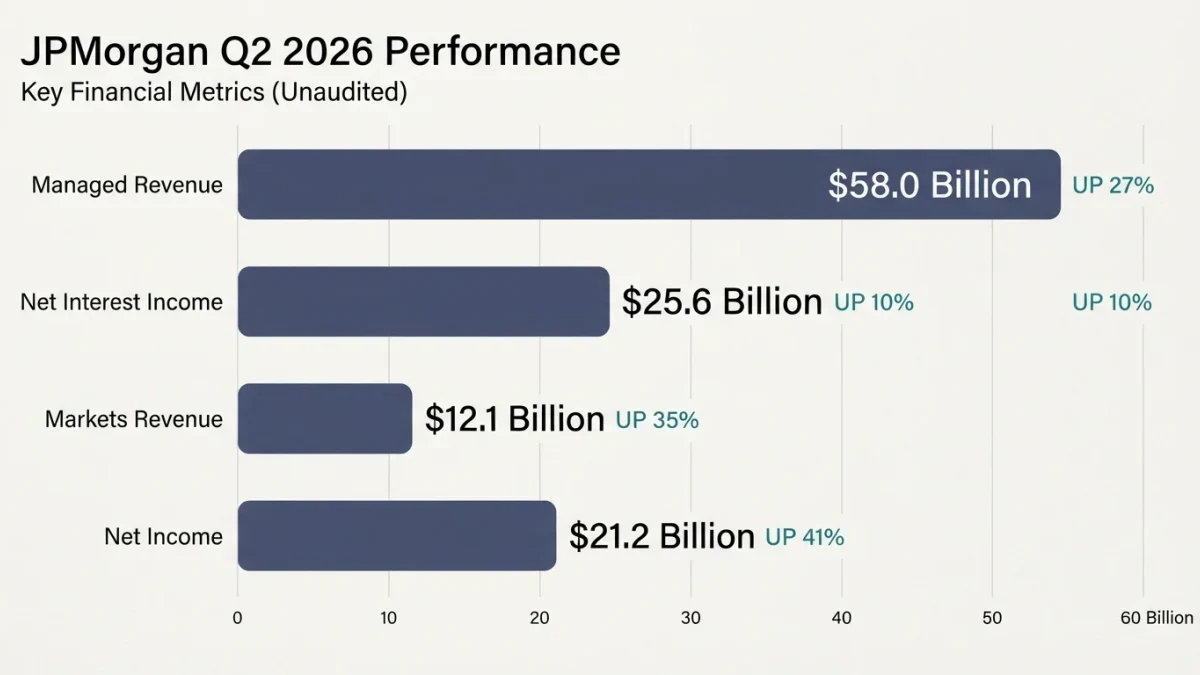

JPMorgan Chase reported second-quarter 2026 net income of 21.2 billion dollars, or 7.70 per share, on July 14 — the highest quarterly profit in the bank's history and, per contemporaneous reporting of the release, the largest quarterly profit ever recorded by an American bank — with managed revenue of 58.0 billion dollars, per the company's published results. Market Today publishes information, not investment advice; this is a factual account of the report and its context.
What drove the record?
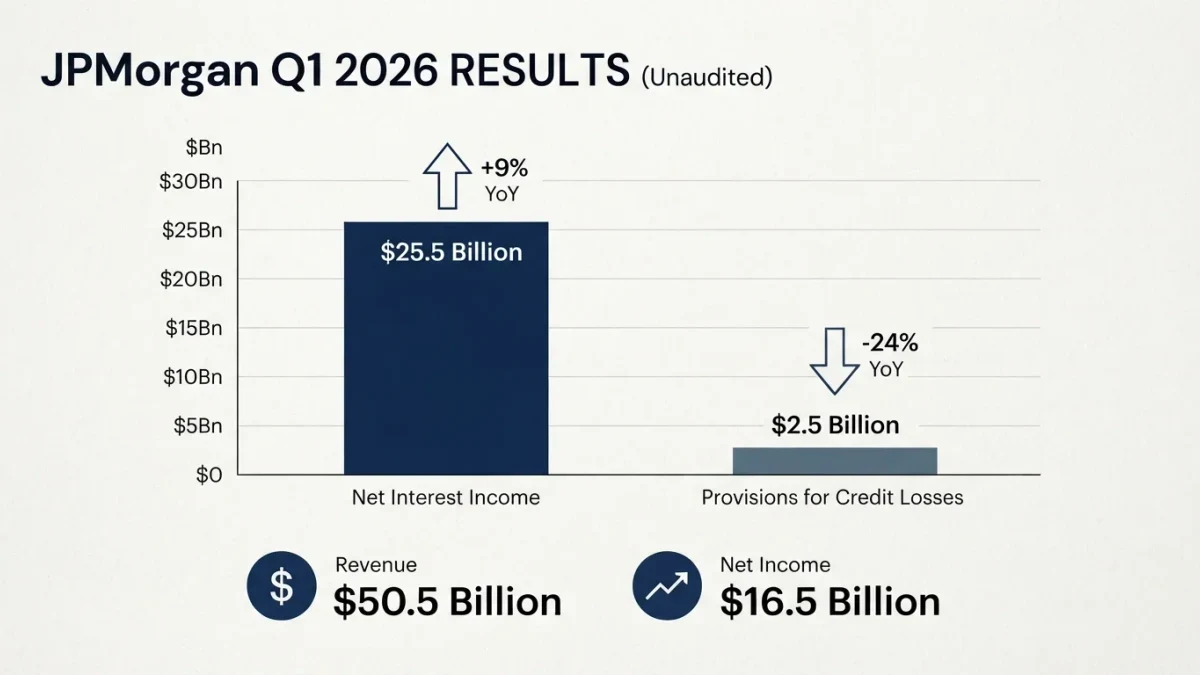
The deal-making revival. The commercial and investment bank earned 9.7 billion dollars on revenue of 24.9 billion, up 27 percent year over year, per the release — an investment banking boom reflecting the surge in announced mergers, acquisitions, and capital-markets activity through the first half of 2026, a rising market's familiar second-order effect. The bank also raised its full-year 2026 net interest income forecast to 96.5 billion dollars excluding markets, up from a prior outlook near 95 billion — management's own arithmetic now embedding a stronger rate-income picture than it projected a quarter earlier.
What does a record bank profit say about the cycle?
Financial-sector earnings are cyclical instruments, and the two engines here mark the cycle's stage. Investment banking revenue peaks with confidence: boards approve acquisitions and issuers come to market when valuations are high and volatility is low — the same conditions that carried the S&P 500 to its record close in early August, covered elsewhere in this publication. Net interest income, the other engine, tracks the rate environment and balance growth. Both engines firing simultaneously is a mid-to-late-cycle signature historically — not a forecast, a fingerprint — and the honest read treats the record print as confirmation of conditions already visible in market data rather than new information about them.
What context did the coverage skip?
Two threads. First, the base question: record dollar profits partly reflect record scale — the banking industry has consolidated for decades, and the largest institution setting the largest dollar record says as much about industry structure as about the cycle; the margin and return metrics in the release's detail tables are the cleaner cyclical gauges. Second, the comparison the record invites: profit records arrived with markets at records, and the same operating leverage that banks enjoy on the way up — trading revenues, deal fees, credit costs near cyclical lows — reverses with the cycle. The release's credit-cost and reserve lines are where that reversal would first print, and they deserve the same attention as the headline.
What happens next, factually?
The rest of the large banks report through the week on their published schedules, opening the second-quarter season. The primary documents — the release, the presentation, and the forthcoming 10-Q — are on JPMorgan's investor-relations site and EDGAR. Readers verifying this account should read the release directly, including the segment detail and the revised outlook language; the tables are the substance.