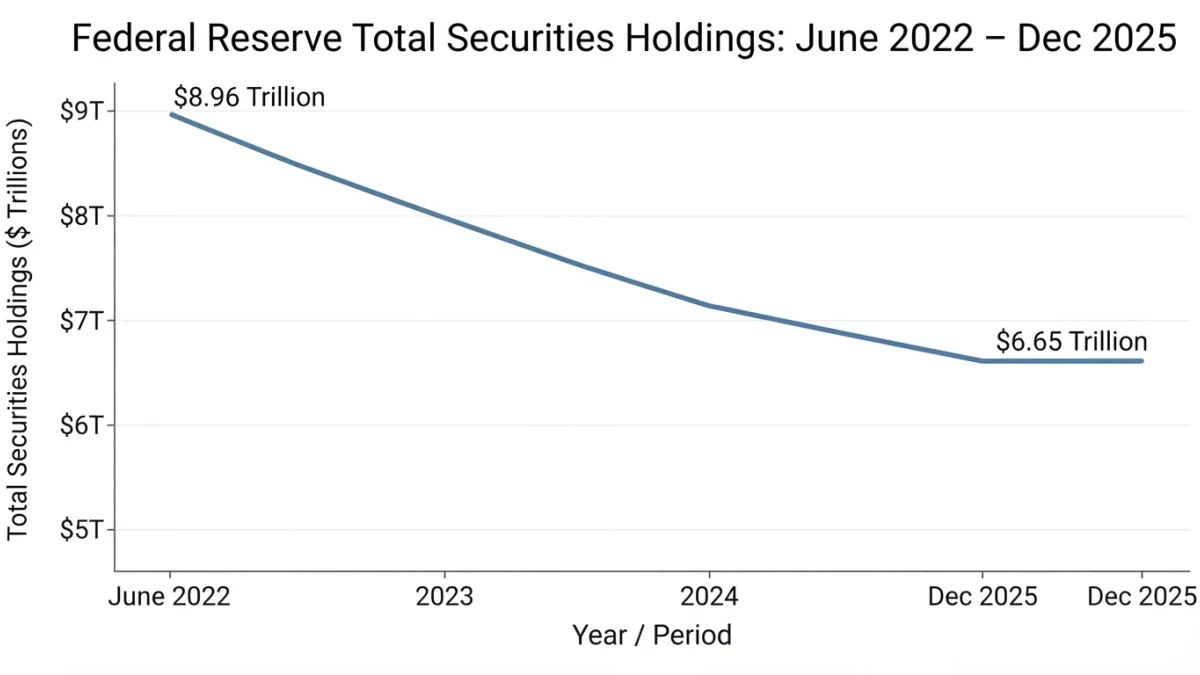
The Federal Reserve's balance sheet rose from under nine hundred billion dollars before the 2008 crisis to about 4.5 trillion by 2015, roughly doubled again during the pandemic to near nine trillion, and has been shrinking under quantitative tightening since 2022 — the largest monetary experiments in modern central-bank history, per the Fed's published balance-sheet data. What these tools actually do, and how much, remains genuinely debated. Market Today publishes information, not investment advice, and this explainer covers the mechanics and the evidence on both sides.
What is quantitative easing, mechanically?
Large-scale asset purchases financed by newly created bank reserves. When short-term rates reach zero and the Fed wants more accommodation, it buys longer-dated Treasuries and agency mortgage-backed securities from dealers, paying with reserves it creates — expanding both sides of its balance sheet in the process. Unlike a rate cut, QE works on the long end: by removing duration from private hands, it lifts bond prices and lowers yields at maturities the funds rate does not directly reach, compressing the term premium investors require to hold long bonds. The Fed ran QE waves in 2008-2014 (three rounds), emergency purchases in March 2020, and then monthly purchases at crisis pace through 2021-2022 — each episode documented in the Desk's statements and the weekly H.4.1 release.
What is quantitative tightening?
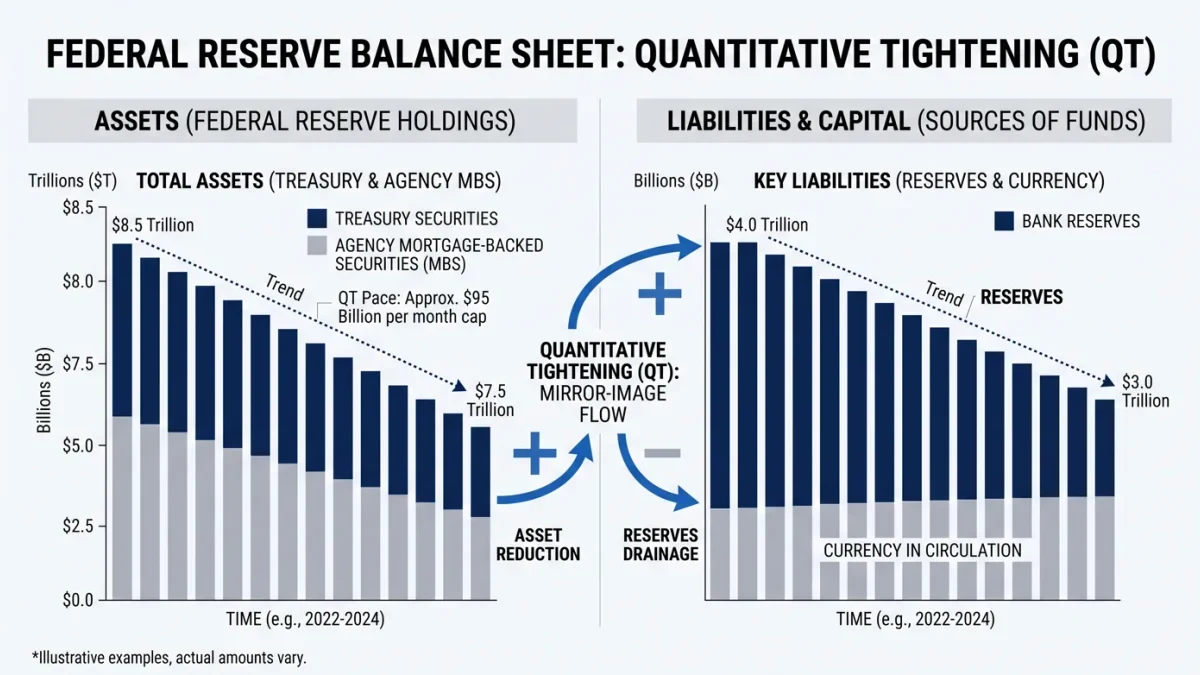
The mirror operation: letting the balance sheet run down. Since June 2022, the Fed has allowed maturing securities to roll off — capped at monthly maximums, initially tens of billions, with principal payments above the cap reinvested — rather than purchasing replacements, per its published rollout principles. Reserves shrink as the holdings mature; the passive design was chosen deliberately, after the 2018-2019 QT episode ended in the September 2019 repo spike when reserves proved scarcer than estimated — a lesson that shaped 2022's slower pace, its cap reductions in 2024, and the standing facilities built as backstops. QT is contraction by drainage rather than by sale: the Fed has avoided active selling (with brief MBS exceptions under discussion), treating runoff as a dial that can slow the moment money markets wobble.
How does QE transmit to the real economy?
Through channels that are individually modest and collectively meaningful. The portfolio-balance channel: with fewer long bonds held privately, investors reach for alternatives — corporate bonds, equities — lowering corporate borrowing costs and raising asset prices. The signaling channel: announcing QE commits the committee to extended accommodation, shifting expectations about the future path of short rates. The market-functioning channel, most visible in 2020: when markets break, central-bank buying restores the basic ability to trade — the March 2020 interventions ended a Treasury-market dysfunction in days, per contemporaneous NY Fed documentation. The transmission to real spending is the weakest link, working through wealth effects and borrowing costs with long lags — which is why QE is powerful in a panic and debated in a recovery.
What is the evidence QE worked?
Strongest at the moments of maximum stress. Event studies of the 2008-2014 rounds find cumulative reductions in ten-year term premiums on the order of a hundred basis points or fractions thereof, per Fed and academic estimates; the 2020 intervention halted a cascade that standard policy could not have addressed at the zero bound; and the recovery comparison — the post-2008 expansion with QE against the 1930s without it — favors the modern toolkit, though attribution across decades is contestable. Inflation undershot the Fed's target through most of the 2010s despite trillions of purchases — evidence against QE being broadly inflationary in normal times — and then inflation surged in 2021-2022 while the balance sheet was still expanding, a sequencing that complicates every simple story. The honest summary: QE's crisis function is proven; its macroeconomic fine-tuning function is supported by models and some estimates, contested by others.
How big is the balance sheet now, and where does it stop?
The honest answer is that the endpoint is discovered, not chosen. Runoff has brought holdings well down from the 2022 peak while reserves remain ample by the Fed's indicators; the committee has said explicitly that the final size depends on the banking system's demand for reserves and the non-monetary holdings — currency, standing facilities — the balance sheet must carry, per its minutes. That discovery process is monitored through the very money-market gauges described above, which is why readers who watch repo spreads and facility usage are watching the QT endpoint being located in real time — a rare case of monetary policy's destination being an empirical fact rather than a decision.
What are the costs and criticisms?
Five with documented substance. Distributional effects: QE lifts asset prices first — equities, bonds, housing — and asset ownership is concentrated, a mechanism critics on both left and right cite, and Fed research acknowledges the channel while debating its size. Fiscal entanglement: a central bank holding a third of the Treasury market becomes intertwined with government financing — and when rates rose in 2022-2023, the Fed itself recorded deferred-asset losses as its portfolio's yield fell below what it paid on reserves, remittances to Treasury collapsing to zero, per its audited statements. Market distortion: a persistent largest buyer changes market structure, as this publication's Treasury-liquidity analysis detailed. Exit risk: every QT has proven harder than every QE — 2019's spike is the canonical evidence. And credibility risk: a tool designed for crises that is used in calms invites the question of where the boundary lies.
How do QT's constraints show up in the data?
Through the reserve-distribution problem the Fed itself publishes on. Banks demand reserves for payments and regulation; below some hard-to-observe level, the floor system wobbles — money-market rates spike relative to target, Standing Repo Facility usage jumps, and volatility appears in repo trading. The Fed has run QT aiming to stop "ample but not excessive" reserves, slowing caps as usage indicators rise: the 2024 cap reductions and subsequent pauses responded to exactly those signals, per FOMC minutes. As of 2026, runoff continues at reduced pace with reserves still measured in the trillions — the experiment ongoing, its endpoint undisclosed even to the Fed, which says so plainly.
Did other central banks run the same experiment?
Yes, with instructive variation. The Bank of Japan pioneered QE decades before the Fed and eventually paired it with yield-curve control — capping ten-year yields outright — an experiment that held for years before being dismantled in 2023-2024 under inflation pressure, per BOJ statements. The European Central Bank bought sovereign debt through the euro-era's deflation years, navigating legal challenges about financing governments that reached its own courts. The Bank of England's QT — active bond sales, not just runoff — ran into a fiscal standoff in 2022 when its gilt sales collided with the government's budget plans, forcing emergency bond-buying even as it tightened otherwise: the era's cleanest demonstration that QE and QT are political economy as much as monetary technique.
What should readers take from two decades of the experiment?
Three durable conclusions. QE is a crisis tool with proven market-restoring power and a macroeconomic effect that is real but imprecise — the estimates disagree because the counterfactual is unknowable. QT is harder than QE every time, and the plumbing signs — repo spreads, facility usage — are the honest gauges of its limits. And the balance sheet has become a standing instrument rather than an emergency relic: at whatever size it settles, the Fed of 2026 operates with a monetary system its 2007 predecessor would not recognize, which is the real legacy of the experiment — the machine was rebuilt while it ran.
Where can readers audit all of this?
The H.4.1 release publishes weekly with every balance-sheet line; the FOMC's rollout principles and minutes document QT decisions; the NY Fed's Desk reports cover operations; and the Fed's annual audited financial statements disclose the deferred-asset position. Every claim above traces to those public documents, and following the H.4.1 alone — one page, every Thursday — is the single best habit for watching the experiment continue.