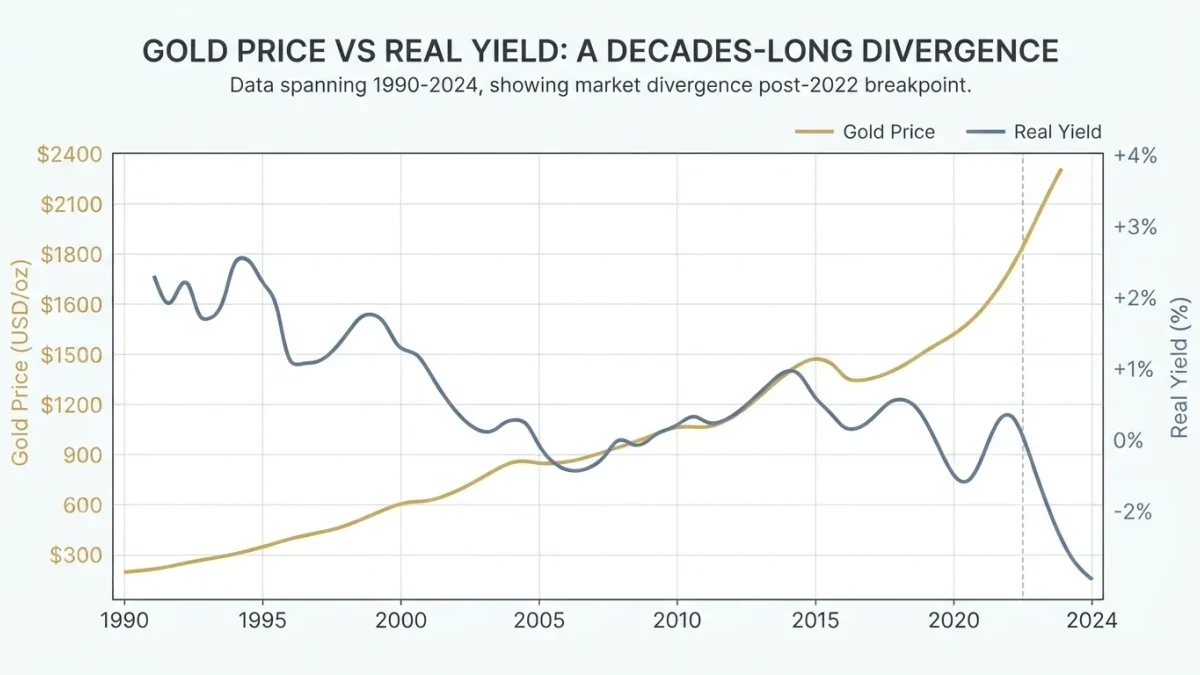
Gold set successive record highs above four thousand dollars an ounce during 2025, per market data, even as inflation-adjusted U.S. Treasury yields sat well above zero — a combination the textbook says should not happen. The textbook is not wrong; it is incomplete.
What is a real interest rate, briefly?
Nominal yield minus expected inflation. A Treasury bond paying four percent while investors expect three percent inflation delivers roughly one percent in real purchasing-power terms; the market reads real rates most directly from Treasury Inflation-Protected Securities, whose yields are quoted after inflation adjustment. Real rates measure the true reward for lending money — and therefore the true cost of holding an asset that pays nothing. That last clause is where gold enters.
Why does gold care about real yields at all?
Because gold pays no coupon, no dividend, and no interest. Every ounce held is a decision to forgo income, and the size of that sacrifice is the real rate. When real yields are high — say, two or three percent — holding cash-like instruments compounds purchasing power safely, and gold's opportunity cost is steep. When real yields fall toward zero or below, the alternative pays nothing in real terms anyway, so gold's disadvantage shrinks; below zero, savers are paying the state to park money, and a metal that merely holds value starts looking rational. The inverse relationship held through long stretches of modern history: real yields sank through the 1970s inflation and gold rose; real yields rose violently under early-1980s Federal Reserve tightening and gold spent two decades in the wilderness; the negative-real-rate years after 2009 and the pandemic accompanied gold's strongest runs, per Treasury and market data across those periods.
What does the dollar have to do with it?
A secondary, reinforcing channel. Gold is priced in dollars worldwide, so a stronger dollar tends to make gold more expensive in other currencies, dampening foreign demand, while a weaker dollar does the reverse. The correlation is real but looser than the real-rate relationship — there are long periods when both the dollar and gold rose together, notably during episodes of broad risk aversion when both serve as havens. The disciplined reading treats the dollar as a modifier on the real-rate core: the direction that matters most is the inflation-adjusted yield, with the currency amplifying or damping the move depending on the regime.
What did the old relationship look like in action?
Two episodes are the canonical exhibits. From 2009 through 2011, the Federal Reserve held policy rates near zero while inflation ran positive, pushing real rates deeply negative; gold roughly doubled to what was then a record above nineteen hundred dollars, with Western exchange-traded funds absorbing hundreds of tons. Then came the 2013 taper episode: mere anticipation of reduced Federal Reserve bond buying lifted real yields sharply in a few months, and gold recorded its worst year in three decades — a fall of roughly a quarter, with ETF outflows of hundreds of tons, per fund and market data. Both moves ran through the investor channel, and both confirmed the hinge: when real yields moved, investor-held gold moved with them, hard.
Why did the relationship break after 2022?
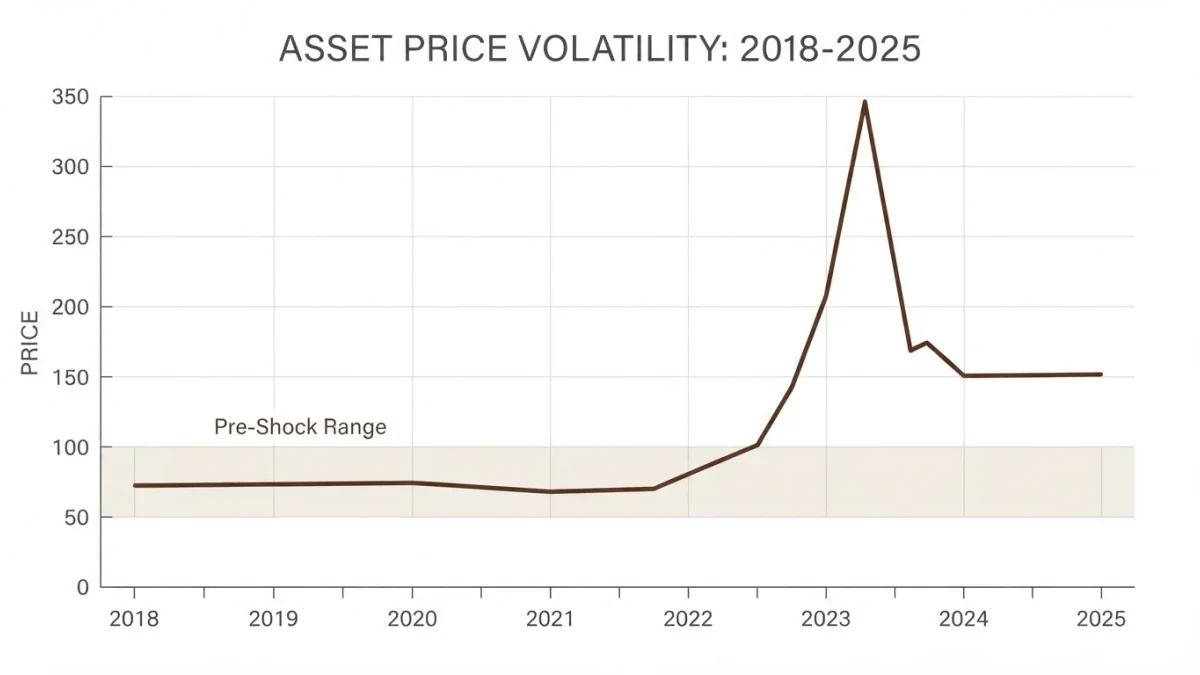
Because a new buyer entered at scale, one that does not compute opportunity cost the way portfolio investors do. Central banks, after being net sellers for years, turned massive net buyers of gold: purchases exceeded one thousand metric tons in each year from 2022 onward — roughly double the pre-2022 pace — per World Gold Council reserve statistics, with Turkey, India, China, Poland, and other official institutions prominent in the reported totals. Roughly a quarter of world demand moved from price-sensitive investors to price-insensitive reserves managers in a few years. The consequence is arithmetic: when real yields rose in 2022–2023 under Federal Reserve tightening, the investor segment of demand retreated exactly as the textbook predicts, but official-sector buying replaced it, and gold held above levels that historical real-rate models implied. The 2024–2025 records extended the pattern.
Why are central banks buying gold now?
The reasons officials give publicly cluster around reserve security. The freezing of Russia's central-bank reserves in 2022 demonstrated that dollar assets carry political counterparty risk; gold held at home cannot be frozen remotely. Gold is also no one's liability — it cannot default, inflate, or be sanctioned at the clearing level — and it diversifies reserves away from the currencies of issuing states. None of this is secret: central bankers state it in official reserve-management reports and World Gold Council surveys, where the share of institutions citing sanctions risk as a reason to hold gold rose measurably after 2022. The buying is structural insurance, not speculation, which is precisely why it is price-insensitive.
What about gold ETFs and retail demand?
They are the elastic part of demand, and they largely follow the old rules. Exchange-traded gold funds, which exploded in the 2004-2012 era and dominated flows again in 2020, are investor vehicles: their holdings rise and fall with real rates, the dollar, and risk sentiment, and Western ETF holdings stagnated during the 2022–2024 rate-hike years while price held — the clean fingerprint of official buying offsetting investor exits. Jewelry demand, still roughly half of global offtake by volume across India and China, is price-aware and seasonal rather than speculative; bar-and-coin demand mixes both instincts. The market's structure, in other words, is a price-sensitive outer ring wrapped around a price-insensitive core that grew.
Does mining supply matter to the price?
Less than in any other major commodity. Annual mine production of roughly three and a half thousand tons adds about 1.5 to 2 percent to the above-ground stock, per World Gold Council data, because nearly all gold ever mined still exists — in vaults, jewelry, and electronics. Gold's stock-to-flow ratio is extreme: the metal is not consumed like oil or copper but accumulated, which is why supply shocks move the price far less than demand shifts do, and why the analytical weight falls on flows of savings and reserves rather than on mine reports.
How should a skeptical reader use the framework?
As a map with a legend. The real-rate channel still governs the investor segment and remains the best first-order explanation of gold's long sweeps; the central-bank channel now sets a floor of demand that the old models did not contain; the dollar modifies both. What the framework forbids is certainty: nobody outside official institutions knows next year's reserve purchases, and nobody anywhere knows the next inflation surprise. The disciplined questions — where are real yields, what did central banks report buying, what is the dollar doing — will not predict gold. They will explain most of its behavior after the fact, which is what honest frameworks do.
What belongs on a gold-watcher's checklist?
A short list of public prints does most of the work. Watch the ten-year TIPS yield for the opportunity-cost channel; the dollar index as the modifier; World Gold Council quarterly demand releases for the central-bank and ETF split; CFTC positioning data for how stretched investor futures bets have become; and, for the macro backdrop, the inflation prints that drive real-rate expectations. Each input answers one question, and no combination of them issues a forecast — the discipline is refusing to let any single dial impersonate the whole machine.
Where can readers check the numbers?
Real yields quote daily from Treasury TIPS data on the Treasury's site; central-bank gold figures publish monthly in IMF reserve statistics and in World Gold Council reports; ETF holdings report daily from the funds themselves. Every claim above traces to those public series, and a reader who tracks the three of them weekly will know more about gold's actual drivers than most commentary provides.