
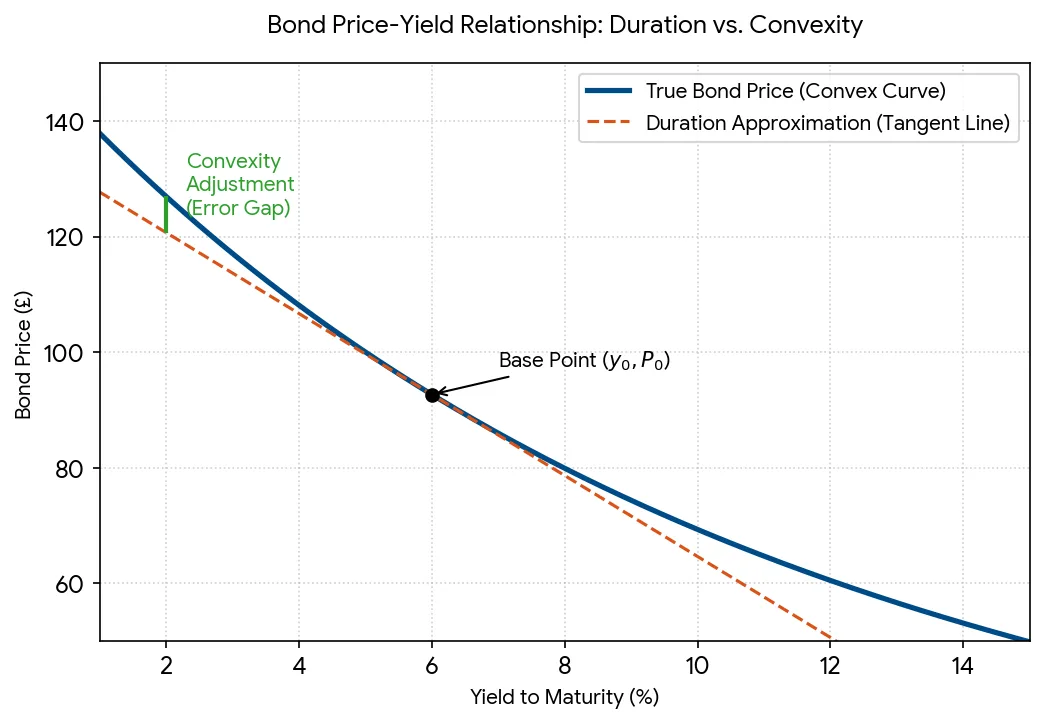
Bond duration measures how sensitive a bond's price is to changes in interest rates. The higher the duration, the more the price falls when rates rise, and the more it rises when rates fall. It is the single most useful number for understanding a bond portfolio's interest rate risk, yet it is the one many holders never look at.
The most important qualification: duration is a measure of price sensitivity, not of risk of loss if you hold to maturity. A bond held until it repays principal returns its face value regardless of what rates do along the way, since as Wikipedia's bond finance entry explains, the issuer is obligated to repay the nominal amount on the maturity date, and has no further obligations once all due payments are made. Duration matters for anyone who might sell before then, or who holds bonds through a fund that constantly marks prices to market.
This piece explains what duration actually measures, why it moves the way it does, and what it implies for building a fixed-income allocation that matches your own time horizon.
What is bond duration, exactly?
Duration answers a question: how many years, on a weighted average, does it take to receive all the cash flows a bond will pay? A bond pays coupons along the way and principal at the end. Duration weights each payment by when it arrives and by its size, then averages. A bond that pays everything back in three years has a duration near three. A bond stretching payments across thirty years has a much longer one. For related coverage, see Why Does One Inflation Report Move Markets So Much?.
That is the textbook definition, called Macaulay duration. The practical version, modified duration, converts it into a price rule: for each one-percentage-point move in interest rates, the bond's price moves roughly its duration in the opposite direction. A duration of six means a one-point rise in rates knocks roughly six percent off the price. The word "roughly" matters — the relationship is not perfectly linear for large rate moves — but as a first approximation it is the standard rule practitioners use.
The mechanism behind it is simple. A bond's coupon is fixed when it is issued. When new bonds pay higher coupons, old bonds with lower coupons must fall in price to offer a comparable yield. The longer you are stuck with the old coupon, the bigger the discount required. That is duration doing its work.
What makes duration higher or lower?
Three features of a bond drive its duration, and all three come straight from its payment schedule.
- Time to maturity. Longer-dated bonds pay principal further out, so more of their value sits in a distant payment. More weight at the end means higher duration.
- Coupon size. Bigger coupons push more cash forward, which pulls the weighted average earlier. A high-coupon bond has less duration than a low-coupon bond of the same maturity.
- Yield level. Higher prevailing yields shrink the present value of distant payments, which modestly shortens duration.
One wrinkle deserves attention: callable bonds can behave differently. If the issuer can redeem early, the expected payment schedule shortens when rates fall, which caps how much the price can rally. Duration on such bonds is a moving target, not a fixed number.
Why does duration matter when rates change?
Because rate moves are the dominant driver of bond returns over short and medium horizons — bigger than credit events for high-quality government debt. A portfolio with a duration of eight loses roughly eight percent of its value if rates rise one point across the curve. That is not a hypothetical tail; it is arithmetic, and it is the same arithmetic in reverse when rates fall.
This is where the distinction between duration and maturity earns its keep. Two bonds can both mature in ten years and carry very different durations if their coupons differ. Maturity tells you when the money comes back. Duration tells you how much pain the wait can cost in the meantime.
For context on what actually pushes yields around day to day — inflation prints, central-bank decisions, auction demand — see What Actually Moves Treasury Yields From Day to Day? The drivers matter because duration amplifies whatever the market does to yields. This connects to our earlier piece, What Actually Moves Treasury Yields From Day to Day?.
What this means for portfolio construction
Duration is a dial, and it should be set against your own horizon rather than against a forecast. The logic is mechanical. If you will need the money in three years, a long-duration portfolio can force you to sell at a loss to raise cash. If your horizon is twenty years, short duration locks in reinvestment risk: coupons and maturing principal get redeployed at whatever rates prevail, and if rates fall, youforfeit the higher locked yields.
Practical steps, in order:
- Find the duration. Fund fact sheets and bond analytics platforms publish it; for individual bonds it is quoted alongside yield and maturity.
- Match duration, loosely, to when you expect to spend the money. This is the core of liability matching, and it works without any rate forecast.
- Decide deliberately whether any extra duration is a bet. Holding duration beyond your horizon is a position that rates will fall or stay flat. It may be a reasonable one. It should be a chosen one.
- Check the duration of what you already own. Many holders discover their "safe" bond fund carries more rate risk than they assumed.
Our analysis: the most common error is not holding too much duration or too little. It is holding duration by accident — inheriting it from a default fund choice and discovering its size only after rates have moved. Duration is not good or bad. Unexamined duration is the problem.
What duration does not tell you
Duration measures rate sensitivity only. It says nothing about credit risk — the chance an issuer fails to pay — or about liquidity, or about inflation eating real returns. A short-duration portfolio of risky corporate debt can lose more money than a long-duration portfolio of government bonds. The two risks stack separately, which is why credit analysis and duration analysis are different jobs. For the credit side, see how sector rotation works for where money moves between bond market segments, and the related piece on what downgrades mean for holders.
Duration also assumes a parallel shift: every maturity's yield moving by the same amount. In reality curves steepen and flatten, and short and long rates can move in opposite directions. Duration is a first-order tool, honest about being one.
The takeaway
The evidence here is definitional, not predictive: duration converts a rate move into an approximate price move, and nothing more. What it establishes is that interest rate risk in bonds is quantifiable before you take it. Check the number, match it to your horizon, and treat any excess as a deliberate position rather than a default. What remains unknown, as always, is where rates go — and no duration figure claims to know.