
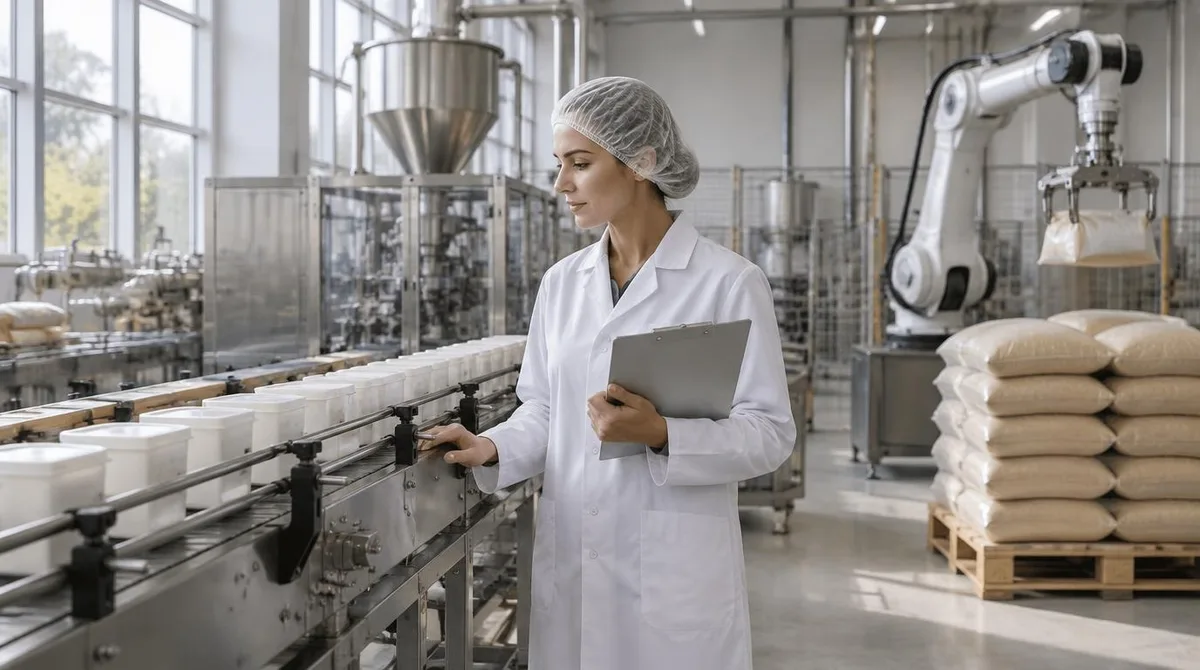
The food processing industry trends that matter most right now come down to three things: automation on the factory floor, supply chains built for resilience rather than pure cost, and a slow shift in what consumers actually buy. The qualification worth holding onto is that this is a capital-heavy sector. Factories and logistics networks change over years, not quarters, so trends show up gradually — and unevenly across companies.
The scale of the system explains why small shifts matter. According to Wikipedia's overview of food, the majority of the world's food energy is supplied by the industrial food industry, which produces food through intensive agriculture and moves it through complex processing and distribution systems. When a system that large retools, the effects ripple back into grain, energy and freight markets.
Why does food processing matter to commodity markets?
Food processing sits between the farm and the supermarket, and it converts raw commodities into the products people actually buy. That makes it a demand signal for grains, oils, livestock and packaging inputs. When processors change what they buy, the demand curve underneath those commodities shifts with them.
The crop mix gives a sense of the exposure. Corn, wheat and rice account for 87 percent of all grain production worldwide, per the same Wikipedia source. Just over half of the world's crops — 55 percent — feed humans directly, while 36 percent becomes animal feed and 9 percent goes to biofuels. Processors sit at the junction of all three uses, so a change in feed demand or biofuel policy changes what a mill or crusher pays for.
For readers tracking the upstream side, our explainer on How Does One USDA Report Set Grain Prices Around the World? covers how crop data reaches these buyers in the first place.
What is automation actually changing on the factory floor?
The honest answer: less than the press releases imply, but more each year. Automation in food processing targets the predictable, repetitive steps — sorting, cutting, filling, palletizing — where labor costs compound and hygiene rules favor machines that are easier to clean than people are to schedule. Vision-based sorting and robotic handling have moved from pilots into standard equipment for large processors.
The constraint is not technology but capital and variability. Food arrives with natural variation — a potato is not a silicon wafer — and retrofitting an older plant costs more than the equipment brochure suggests. So adoption concentrates where volumes are high and product variation is low. Smaller processors automate selectively, usually at the end of the line where palletizing robots pay back fastest.
What this means for commodity watchers: automation reduces a processor's sensitivity to labor markets but raises its sensitivity to energy and equipment costs. The input mix shifts, it does not shrink.
How are supply chains being rebuilt?
After several years of disruption, processors have been trading some efficiency for redundancy. The practical signs are more dual-sourcing of ingredients, larger buffer stocks of critical inputs, and closer attention to where freight costs sit in the margin math. None of this is exotic; it is a return to inventory as insurance.
Freight is the visible edge of this shift. Shipping costs feed directly into landed ingredient costs, and they move before shelf prices do. Our piece on Freight Rates and Commodities explains why shipping costs often signal price moves early. The same logic applies to a container of cocoa butter or a bulk grain cargo. We covered a connected angle in Freight Rates Commodities — Freight Rates and Commodities: What Shipping Costs Signal Before Prices Move.
Soft commodities illustrate the risk sharply. The recent cocoa price shock showed how a supply problem in one growing region can overwhelm any processor's hedging playbook. Our analysis of What the Cocoa Price Shock Teaches About Soft Commodity Risk walks through that episode. Diversified sourcing is the industry's answer, though for crops grown in narrow climate bands, diversification has limits.
Is consumer demand really changing what processors make?
Yes, but slower than the trend pieces claim. Demand shifts in food are real and measurable — more plant-based formulations in some categories, more scrutiny of ingredients, more convenience formats — but they arrive through product-line turnover, not overnight plant conversions. A processor's portfolio changes one SKU at a time.
The classification systems regulators use give a hint of how granular this gets. The Food and Agriculture Organization and World Health Organization use a system with eighteen or nineteen food classifications, ranging from cereals and milk products to food additives and savory snacks, according to the Wikipedia source. Every one of those categories has its own demand dynamics, its own input costs and its own competitive field. "Food processing" is not one industry so much as several dozen, loosely stapled together.
What about energy and emissions pressure?
This is the trend with the longest shadow. The food system relies heavily on fossil fuels, and food and agricultural systems account for as much as 37 percent of total greenhouse gas emissions, per the Wikipedia overview. Processors sit in the energy-intensive middle of that system — drying, heating, refrigerating and packaging all consume significant power.
That creates two pressures at once. First, energy costs are a direct input to margins, which ties processors to the same price swings that move crude and natural gas markets. Second, buyers and regulators increasingly ask processors to account for emissions across their supply chains, which pushes investment toward efficiency and lower-carbon energy even where payback periods are long. Our explainer on Why Do Natural Gas Prices Swing So Violently With the Seasons? covers the energy-price volatility processors absorb.
Our analysis: what to actually watch
The consensus assumes food processing trends are a consumer story. The evidence suggests the more reliable signals are industrial: capital spending on automation, inventory behavior, freight costs and energy exposure. Those show up in filings and commodity data before consumer surveys move.
A note on market size: widely cited estimates of the food processing market's dollar value exist, but the supplied evidence for this article does not include one, so no figure is offered here. Treat any specific market-size number you encounter as an estimate, and ask who produced it and for what period before using it.
The restrained lesson for anyone following the sector: watch what processors buy, not what they say. Input choices — grain, energy, freight, packaging — are the industry's real disclosures.